IntegralDots DevGate API developer portal
A self-hosted developer portal for IBM API Connect, in English and Arabic.
With DevGate, developers find your API products, compare plans and rate limits, and build from a clear API reference. DevGate runs on your own infrastructure, down to a single machine, and reads everything from API Connect, so the gateway stays the system of record. The catalogue and reference are available now; developer self-service is in development.
- GatewayIBM API Connect v10
- RunsOn your servers, down to one machine
- StoresNo products, apps or credentials
- LanguagesEnglish and Arabic
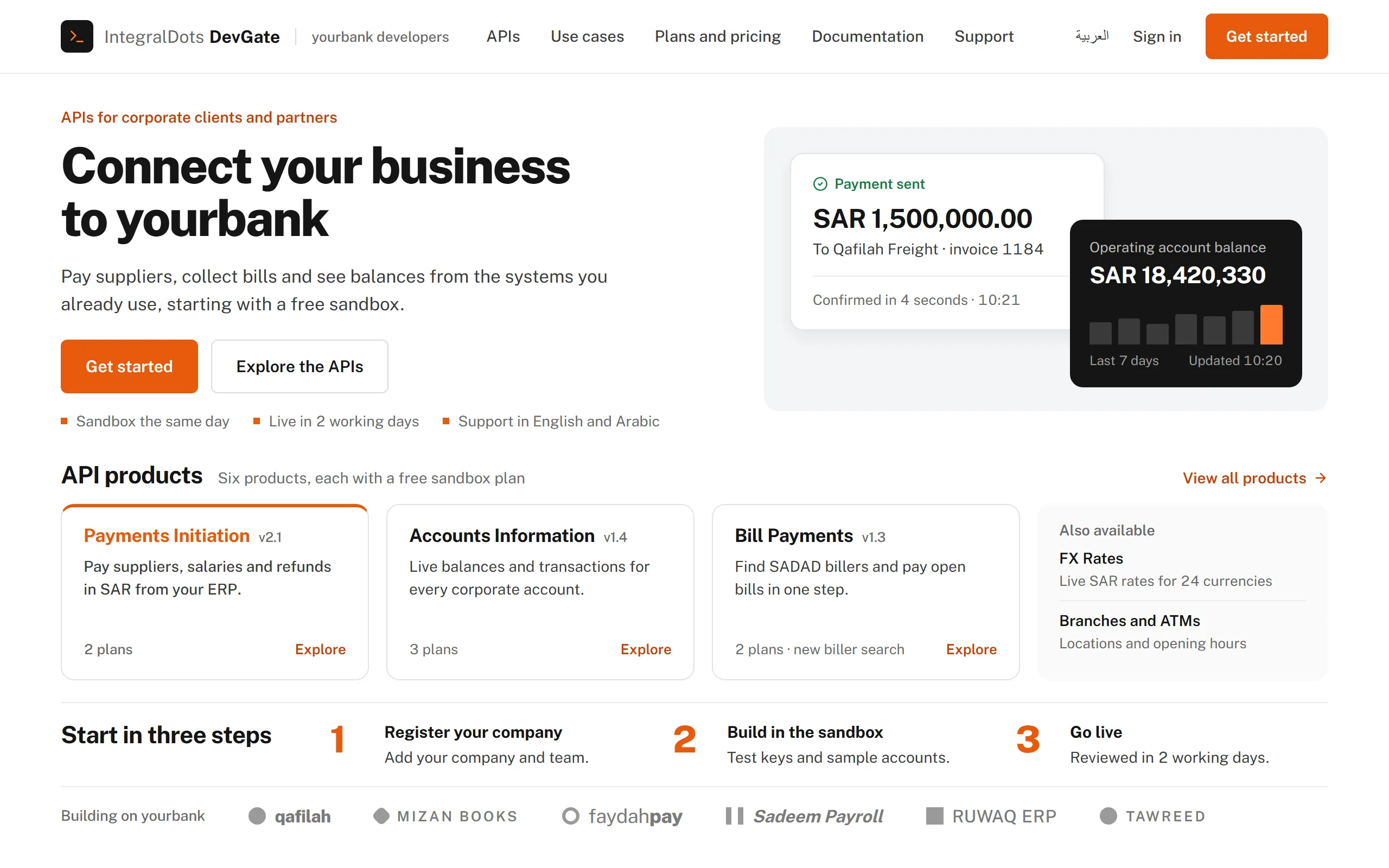
- The bank's developer homeA public home page in the bank's name for corporate clients and partners. Every product can be read without an account.
- What the APIs doExamples the bank chooses, in business terms: a supplier payment confirmed and an account balance.
- API productsProducts, versions and plans as published in API Connect, each with a free sandbox plan.
- Three steps to startRegister, build in the sandbox, go live. Sign-up and apps are in development. Home page content comes with the planned admin console.
Product screens show demo data for a fictional bank. Some show features that are in development or planned; see what is available now.
API programmes stall in the developer's first hour.
A bank publishes APIs in API Connect. Then partners and internal teams wait on email for the contract file, the base URL, the plan limits and a test credential. A portal should remove that wait, but it also has to pass a security review, run inside the bank's network and serve Arabic-speaking developers properly.
- Integration by emailContract files, base URLs and limits are sent by hand, and every partner asks the same questions.
- Two sources of truthA portal that keeps its own copy of products and subscriptions can show access the gateway has already revoked.
- Hard to hostBank networks expect software that installs inside the boundary and calls nothing outside it at run time.
- English onlyArabic-speaking developers and business owners get a translated afterthought, if anything.
DevGate reads from the gateway you already run.
Your API team keeps working in API Connect. DevGate reads from it, caches what it reads, and adds the parts the gateway does not hold: sessions, content and an audit trail.
Install
Container images and one Docker Compose command start the portal and its PostgreSQL database. A built-in API Connect simulator lets you evaluate it before connecting a gateway.
Connect
Point the portal at an API Connect v10 provider organisation and its catalogs. It reads products, plans and API documents through the gateway adapter.
Publish as usual
Changes you publish in API Connect appear on refresh. Reads are served from cache, so browsing continues when the gateway is slow or unavailable.
Developers self-serve
Visitors browse the catalogue and API reference today. Organisations, apps, credentials, subscriptions and Try it are in development.
What the portal covers.
Products, plans and rate limits
Products with version and state, the APIs in each, and every plan's rate limits, burst limits and approval rule, read from API Connect.
One view for OpenAPI 3 and Swagger 2
Operations, parameters, bodies, responses and schemas with constraints and examples. Provider configuration is removed and addresses point at your gateway.
English and Arabic
The developer portal works in both languages, with a right-to-left layout in Arabic. API names, paths and examples stay as published.
API Connect first, other gateways later
All gateway access goes through one adapter interface with its own contract tests. API Connect v10 is the first adapter; others are planned behind the same interface.
Accounts, apps and subscriptions
Sign-in against the catalog's user registry works today. Sign-up, consumer organisations, apps, credentials and subscriptions are being built.
Try it through your gateway
Requests sent from the reference through the portal's own proxy, which forwards only to your catalog's gateway, with code samples in four languages.
What exists today, and what comes next.
DevGate is in early access. This is where it stands.
Catalogue and reference
- Catalog switch, for example sandbox and production
- Products, plans, rate and burst limits, approval rules
- API reference for OpenAPI 3 and Swagger 2
- English and Arabic
- Cached reads when API Connect is slow
- Built-in API Connect simulator for evaluation
Developer self-service
- Accounts: sign-in works; sign-up and password reset next
- Consumer organisations, members, roles and join requests
- Apps and credentials, with secrets shown once
- Subscriptions to plans, including approval
- Try it through the portal's proxy, with code samples
Product features and hardening
- Several catalogs and provider organisations in one installation
- White-label branding by configuration
- Admin console and managed content, with Arabic and right-to-left layout
- SOAP and GraphQL APIs in the reference
- Exports: OpenAPI files, Postman collections, integration guides
- Hardening: security testing, SBOM, Helm chart, install guide
- Adapter validation on a licensed API Connect instance
- Other gateways: Apigee, Kong, Azure API Management, WSO2
What partners and the API team see.
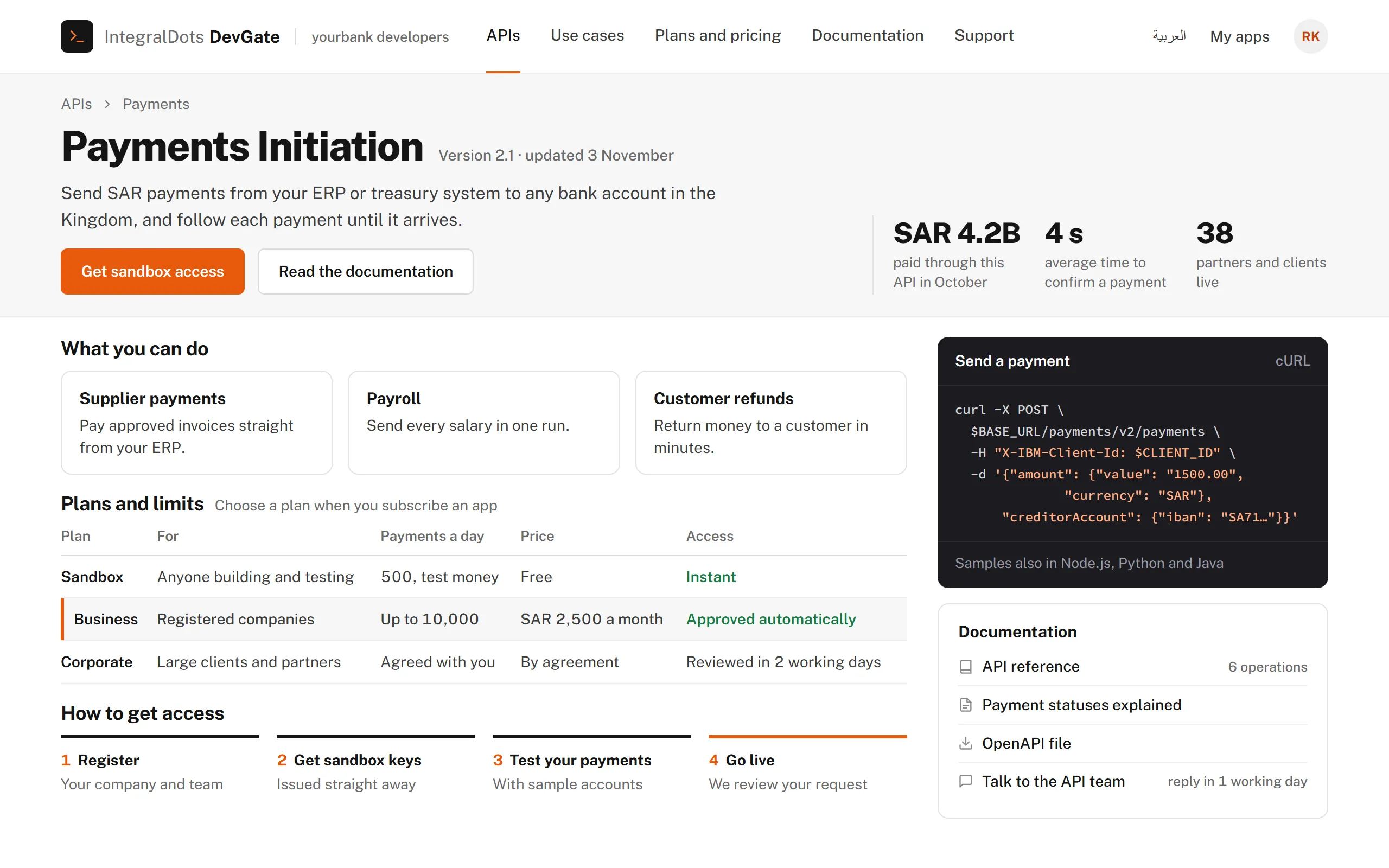
A product page in business terms
Each API product gets a page a business owner can read: what it does, the plans and limits, and how to get access. The full API reference is one click away and available now. Code samples and self-service access are in development and shown here as designed.
- What it doesThe product name, version and a one-line description, with the next step for a new visitor.
- Key figuresPlanned with managed content: figures the bank chooses to show, such as value paid and partners live.
- Use casesThe jobs the API does, described for the business reader.
- Plans and limitsEach plan with who it is for, the daily limit, the price and how access is approved, read from API Connect.
- Code sampleIn development: one short sample beside the page. The full API reference it links to is available now.
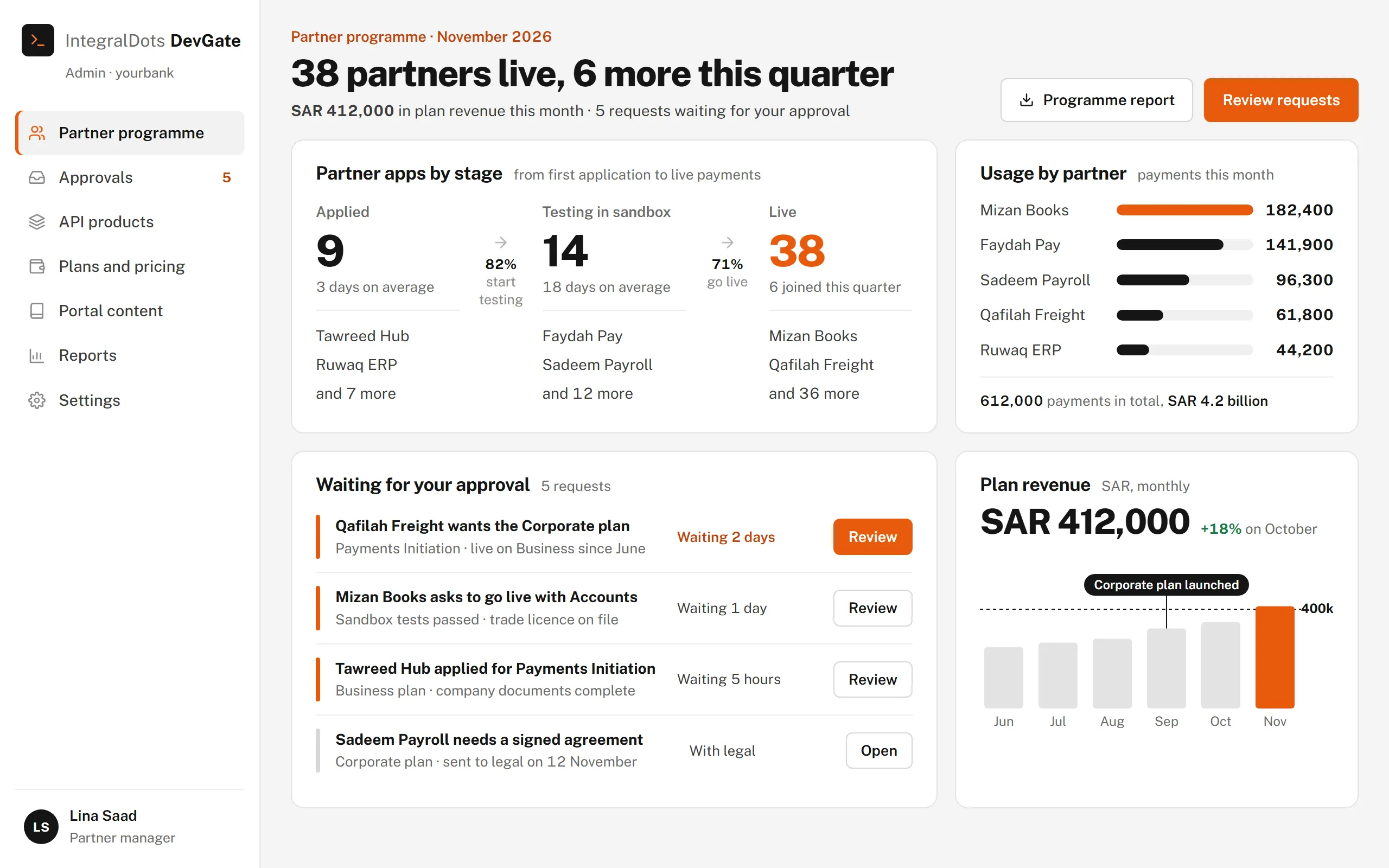
The partner programme at a glance
Planned for the admin console. The partner manager sees every partner app by stage, the requests waiting for a decision, usage by partner and plan revenue. Plans and subscriptions stay in API Connect, and DevGate reads them from there.
- Partners livePartners live, new partners this quarter, plan revenue this month and requests waiting.
- Apps by stageApplied, testing in the sandbox and live, with the average time in each stage and how many move on.
- Usage by partnerPayments sent by the largest partners this month.
- Waiting for approvalPlan upgrades and go-live requests, oldest first, each with a Review button.
- Plan revenueMonthly plan revenue against the target, with the Corporate plan launch marked.
Runs inside your boundary.
Designed for bank security reviews: your servers, nothing loaded from outside at run time, and gateway tokens that never reach the browser.
Deployment
- Container images and Docker Compose; one machine is enough
- Built-in API Connect simulator for evaluation without a gateway
- PostgreSQL for sessions, content, settings and audit
- Helm chart for Kubernetes planned with the hardening phase
Security
- Server-side sessions in HttpOnly, SameSite=Strict cookies
- Developer tokens stay on the server and never reach the browser
- Passwords are never stored; sign-in goes to the catalog's user registry
- Sign-in throttling and lock-out, and a CSRF check on every change
Governance
- API Connect stays the system of record for products, apps and credentials
- Client secrets are never stored by the portal
- An audit trail of portal actions in PostgreSQL
- No telemetry and no third-party code loaded from a CDN
Integration
- IBM API Connect v10 platform and consumer APIs
- The catalog's user registry, LDAP or local, through API Connect
- A gateway adapter interface with contract tests for each gateway
- Apigee, Kong, Azure API Management and WSO2 planned
- OpenAPI 3.0 and 3.1
- Swagger 2.0
- OAuth 2.0
- PDPL data handling
- OWASP ASVS Level 2 as the hardening target
Questions API teams ask
What can we use today?
The catalogue (products, plans and rate limits), the API reference for OpenAPI 3 and Swagger 2, catalog switching, and English and Arabic, with developer sign-in. Organisations, apps, credentials, subscriptions and Try it are in development. Early access lets your team evaluate the portal now and shape what comes next.
Does DevGate keep its own copy of our products and apps?
No. API Connect stays the system of record. DevGate reads products, plans and documents from the gateway and keeps only a short-lived cache, plus its own sessions, content, settings and audit log.
Can we evaluate it without connecting our API Connect?
Yes. It ships with an API Connect simulator seeded with a fictional bank, so the whole portal runs on one machine with Docker and nothing else.
Which gateways does it support?
IBM API Connect v10 first. All gateway access goes through one adapter interface with contract tests, so Apigee, Kong, Azure API Management and WSO2 can be added behind it. They are planned, and none is available yet.
Is Arabic built in or translated later?
Built in. The developer portal is laid out right-to-left in Arabic from the first screen, and its interface text exists in both languages. API names, paths and examples are shown as published. Arabic in the admin console is planned.
Related products
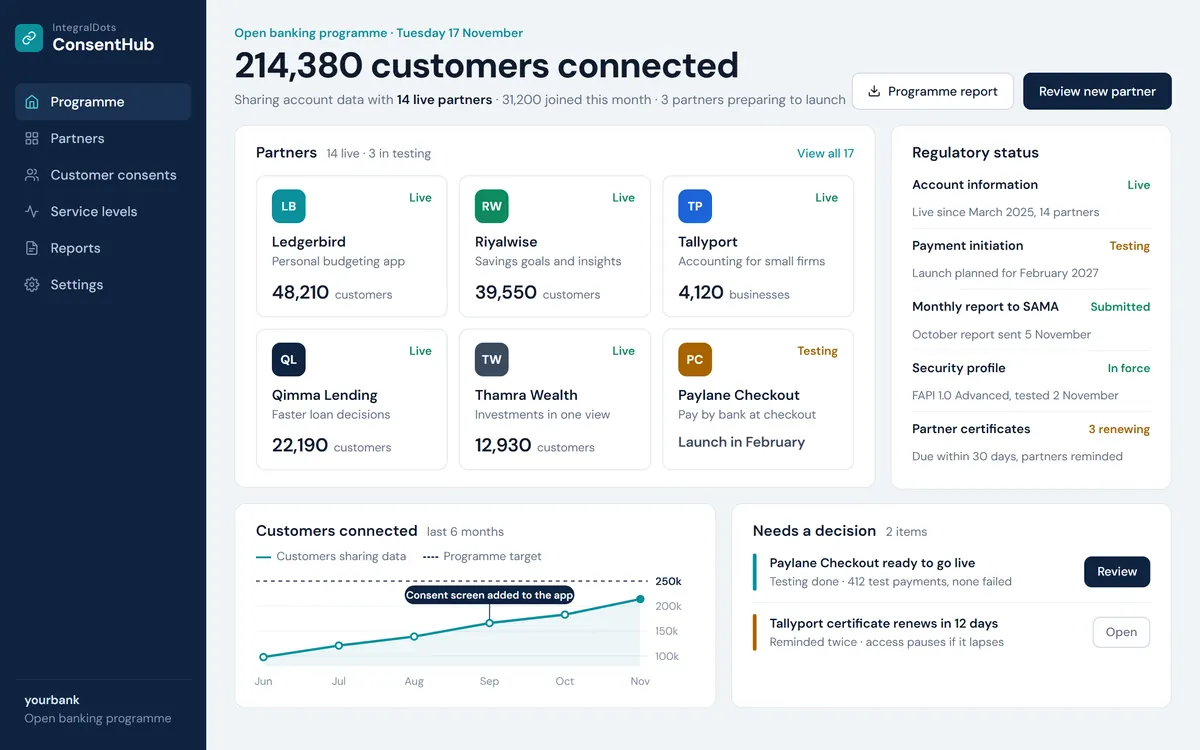 Open finance
ConsentHub Open banking platform
Account information and payment initiation under the SAMA framework, with consent and TPP management.
Explore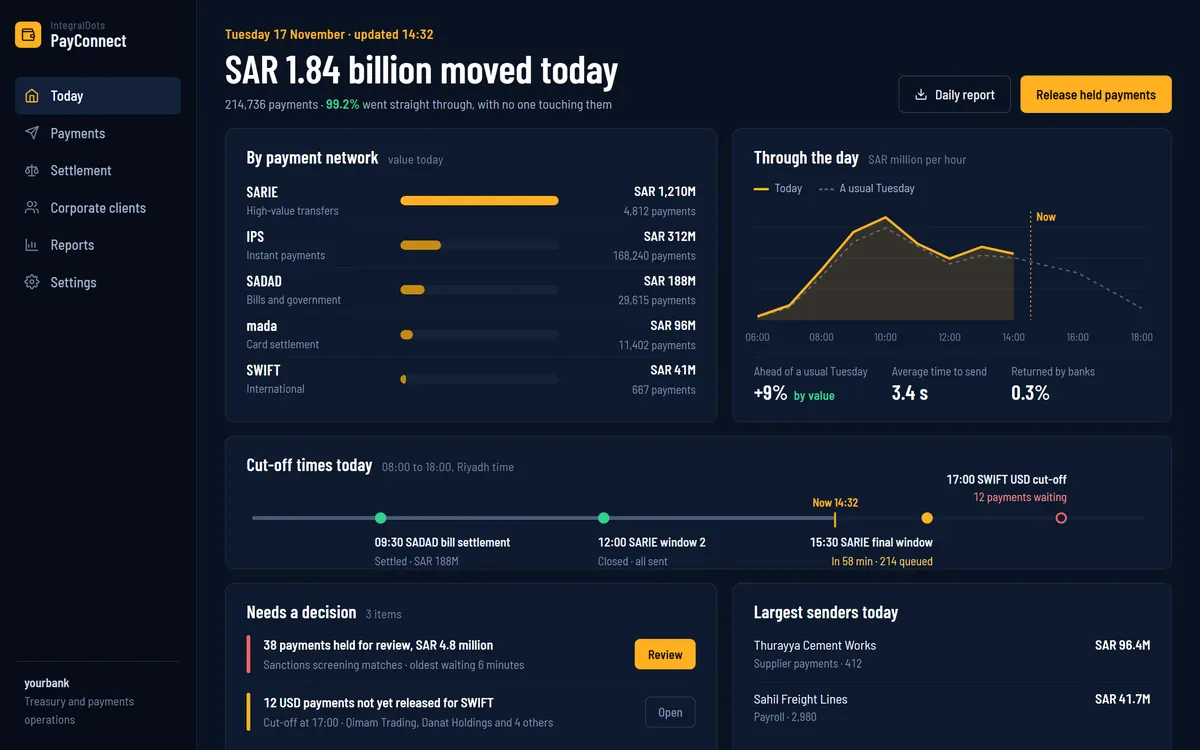 Payments
PayConnect Payment integration suite
ISO 20022 connectivity between your payment hub and core banking for instant, bulk and biller payments.
Explore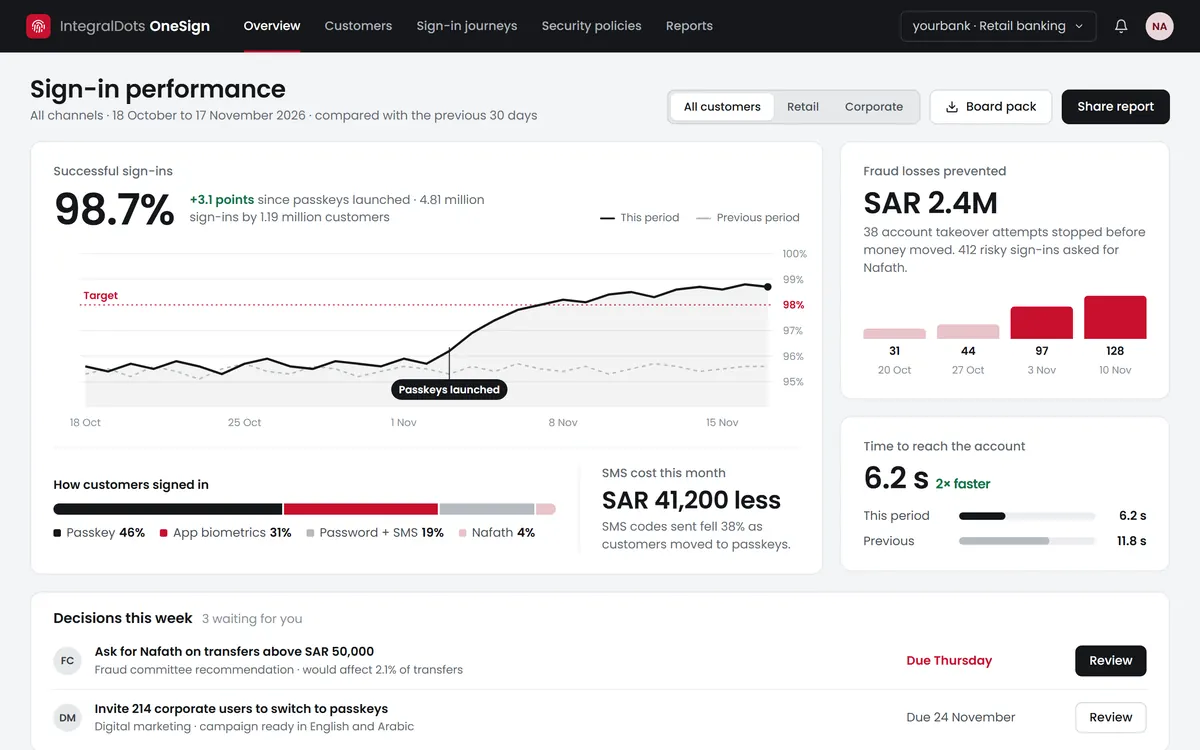 Identity
OneSign Customer identity and access (CIAM)
One customer identity across every channel, with risk-based authentication and Nafath federation.
Explore