IntegralDots EnforceDesk Enforcement execution for Tanfeeth
Enforcement orders executed under versioned rules, with proof of every step.
EnforceDesk sits between the enforcement channel and your core banking system. It executes account blocks, garnishments, transfers and lifts as versioned catalogue services, records each obligation in a typed ledger, reconciles it against core banking, and keeps a tamper-evident record for the regulator and your auditors.
- ExecutesBlocks, garnishments, transfers and lifts
- Connects toAny core banking system, through connectors
- Changes ship asVersioned configuration packs
- Built forBanks under SAMA enforcement mandates
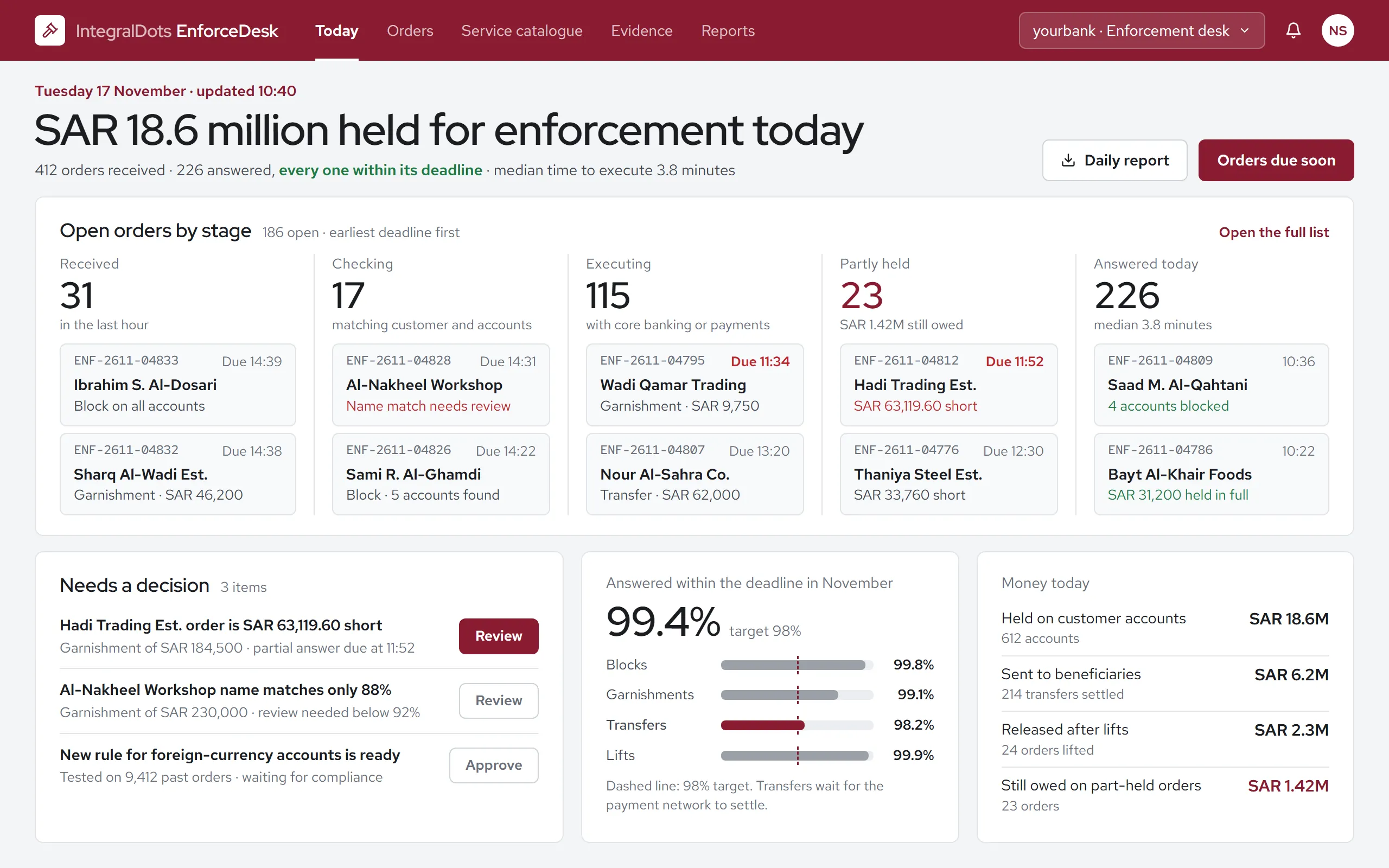
- Today at a glanceSAR 18.6 million held for enforcement today. 412 orders received, and all 226 answered so far met their deadline.
- Orders by stageOpen orders from received to answered, earliest deadline first. A deadline that is close shows in red.
- Partly heldOrders where the balance did not cover the amount, with the shortfall still owed. New credits are held until the order is met or lifted.
- Needs a decisionShortfalls, weak name matches and rule changes waiting for a person, each with a Review or Approve button.
Product screens show demo data.
Enforcement orders are deadlines with legal weight.
Banks receive court orders and regulator mandates to block accounts, garnish balances, transfer held funds and lift restrictions, each with a window to respond. In many banks the execution logic is spread across core-banking customisations, middleware scripts and manual desk work. Each new requirement becomes a project, and proving what was done, and when, takes days.
- Hard-coded logicExecution rules sit in core-banking code and scripts, so a new order type or rule change waits for a release.
- Partial execution by handBalances across several accounts, foreign-currency holdings and closed accounts are easy to get wrong under time pressure.
- Late reconciliationNo single record ties each order to the holds, transfers and lifts it caused, so breaks surface weeks later.
- Slow evidenceWhen the regulator or internal audit asks what happened to an order, teams rebuild the answer from logs and email.
From order received to obligation closed.
Every order follows the same five steps. Your compliance team sets the rules; EnforceDesk applies them the same way every time and records the result.
Receive
Orders arrive from the enforcement channel through a connector. Each one is validated, checked for duplicates and given an SLA clock.
Resolve
The subject is matched to the bank's customers and accounts, and the order goes to the catalogue service and version that applies.
Execute
The service applies your rules for accounts in scope, allocation, partial execution and currency. The core-banking connector places the hold, transfer or lift.
Record
Each step becomes a typed ledger entry and an event in the hash-chained store. The response carries the actual result.
Reconcile
The reconciliation engine matches orders, ledger, core banking and payment settlement, and gives every break an owner.
Rules that change by configuration, with evidence for each order.
Enforcement services as versioned content
Each order type is a catalogue service with an owner, a version and a lifecycle: draft, simulated, approved, live, retired. New requirements ship as configuration packs.
Business rules as configuration
Accounts in scope, allocation order, partial execution, protected balances and currency handling are set in readable configuration and reviewed by compliance before release.
A connector SDK for any core
Bank-specific integration sits behind a stable connector contract, so the same catalogue runs on different core banking, payment and notification systems.
Typed obligation ledger
Obligations, holds, shortfalls, transfers and lifts are typed entries whose amounts must balance. Each order's position is known at any moment.
Tested on recorded traffic
Before promotion, a new version is replayed against recorded, masked orders. Every changed outcome is listed and has to be expected.
Tamper-evident audit and SLAs
Hash-chained events, SLA clocks per mandate, daily reconciliation and evidence packs ready for the regulator and internal audit.
Built for the enforcement desk, compliance and audit.
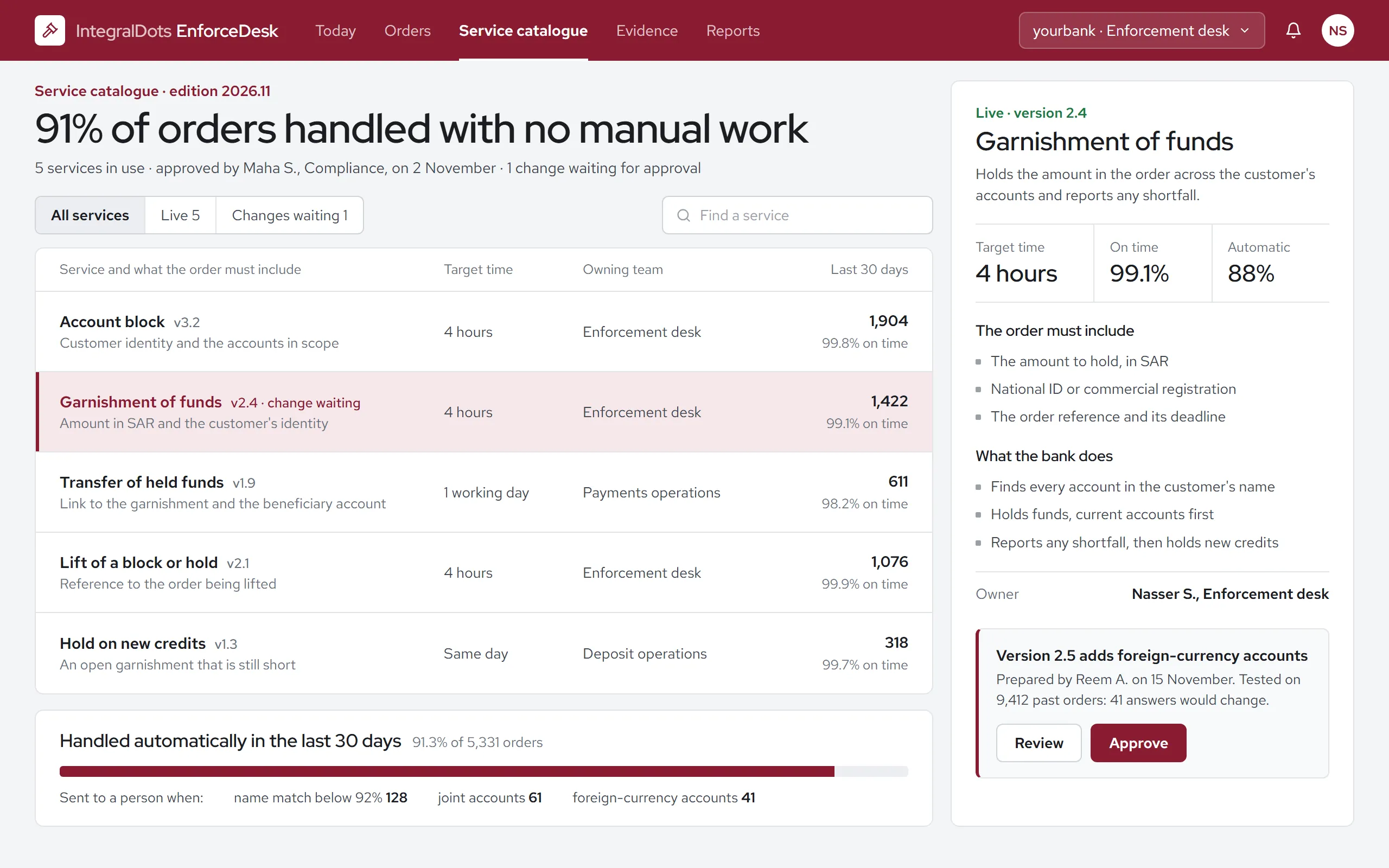
Each order type is a service with an owner
The catalogue lists the services the bank runs for enforcement orders: what each order must include, the target time, the owning team and how the service performed over the last 30 days. Open a service to see what the bank does with it and any change waiting for approval.
- ServicesFive services with what each order must include, the target time, the owning team, and 30-day volume and on-time rate.
- Change waitingThe garnishment service is flagged because version 2.5 is waiting for approval.
- Handled automatically91.3% of the last 5,331 orders needed no manual work, with the reasons the rest went to a person.
- Service detailTarget time, on-time rate and automatic share, what the order must include, what the bank does, and the owner.
- ApprovalVersion 2.5 tested on 9,412 past orders, with the 41 answers that would change, ready to review and approve.
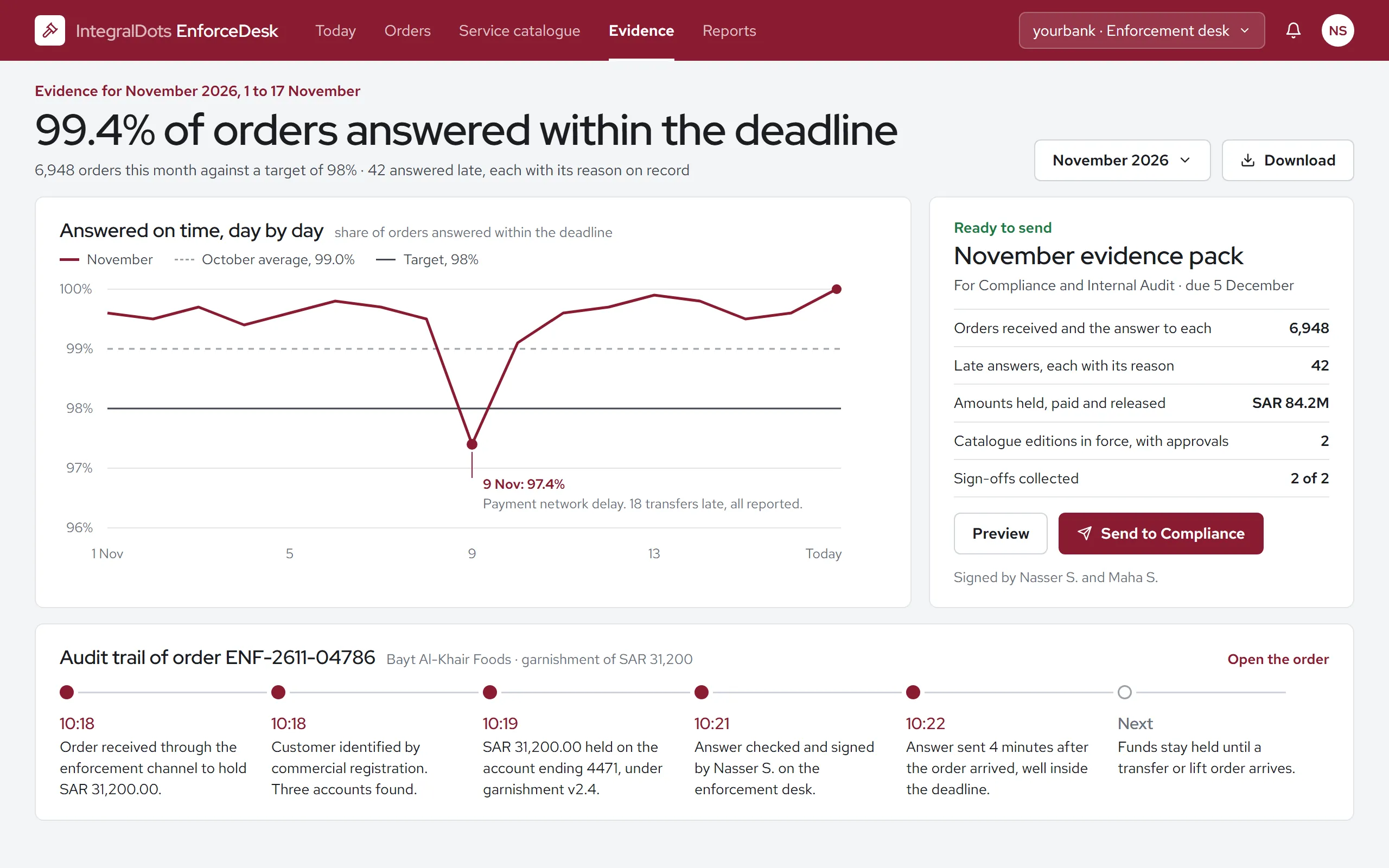
Evidence for the month, ready to send
Compliance sees the share of orders answered within the deadline, day by day against the target and last month, with any dip explained. The month's evidence pack builds up as orders are handled, and each order keeps a plain-language record of what happened and who signed.
- Month to date99.4% of 6,948 November orders answered within the deadline, against a 98% target. Every late answer has its reason on record.
- Day by dayEach day's on-time share against the target and October's average.
- The dip explainedA payment network delay on 9 November made 18 transfers late. The note sits on the chart where it happened.
- Evidence packOrders and answers, late answers with reasons, amounts held and released, catalogue editions and sign-offs, ready to send to Compliance.
- One order's trailGarnishment ENF-2611-04786 from receipt to answer in plain sentences, with each time, the rule applied and the person who signed.
Runs inside your boundary, under your controls.
Built for execution that carries legal weight. It runs on your infrastructure with your identity provider, and its evidence stands up to review.
Deployment
- Your data centre or private cloud tenancy
- Multi-tenant ready, with separate data, configuration and keys per tenant
- High-availability setup with health checks and alerting
- Separate environments for build, simulation and production
Security
- Single sign-on with your identity provider and role-based access
- Maker-checker on catalogue, rule and connector changes
- Encryption in transit and at rest
- National IDs and account numbers masked by role in screens and exports
Governance
- Hash-chained event store, anchored daily to write-once storage
- Every execution tied to the service version and rules behind it
- Evidence packs for regulator and internal-audit requests
- Retention that follows your records policy
Integration
- Connector SDK for core banking, payment hub and notification services
- REST APIs, message queues or your existing integration layer
- ISO 20022 messages for transfers through the payment hub
- Events to your SIEM, data platform and operations dashboards
- SAMA Cyber Security Framework controls
- PDPL data handling
- ISO 20022
- OAuth 2.0 and OpenID Connect
- OpenAPI
Questions compliance and technology leaders ask
Does EnforceDesk replace our core banking system?
No. Holds, transfers and lifts are still applied in your core banking system. EnforceDesk decides what to do under the configured rules, calls the core through a connector, then records and reconciles the result.
How do we handle a new regulatory requirement?
Usually as configuration: a new version of the affected catalogue service, or a new service, released in a configuration pack. It is simulated against recorded traffic and approved by a second person before it goes live. Code is needed only when a connector must call a core-banking function it does not use yet.
What happens when an order cannot be fully executed?
The ledger records what was held and the shortfall, and the response carries the actual result. Cases the rules do not cover, such as a closed account, go to the enforcement desk with the context needed to decide.
Will it work with our core banking system?
Yes. Bank-specific integration lives in connectors built with the SDK against a stable contract. A connector can use your core's APIs, message queues or your integration layer, so the catalogue and rules stay the same.
Can several entities share one installation?
Yes. EnforceDesk is multi-tenant ready: each tenant has its own catalogue versions, rules, connectors, data and audit chain.
Related products
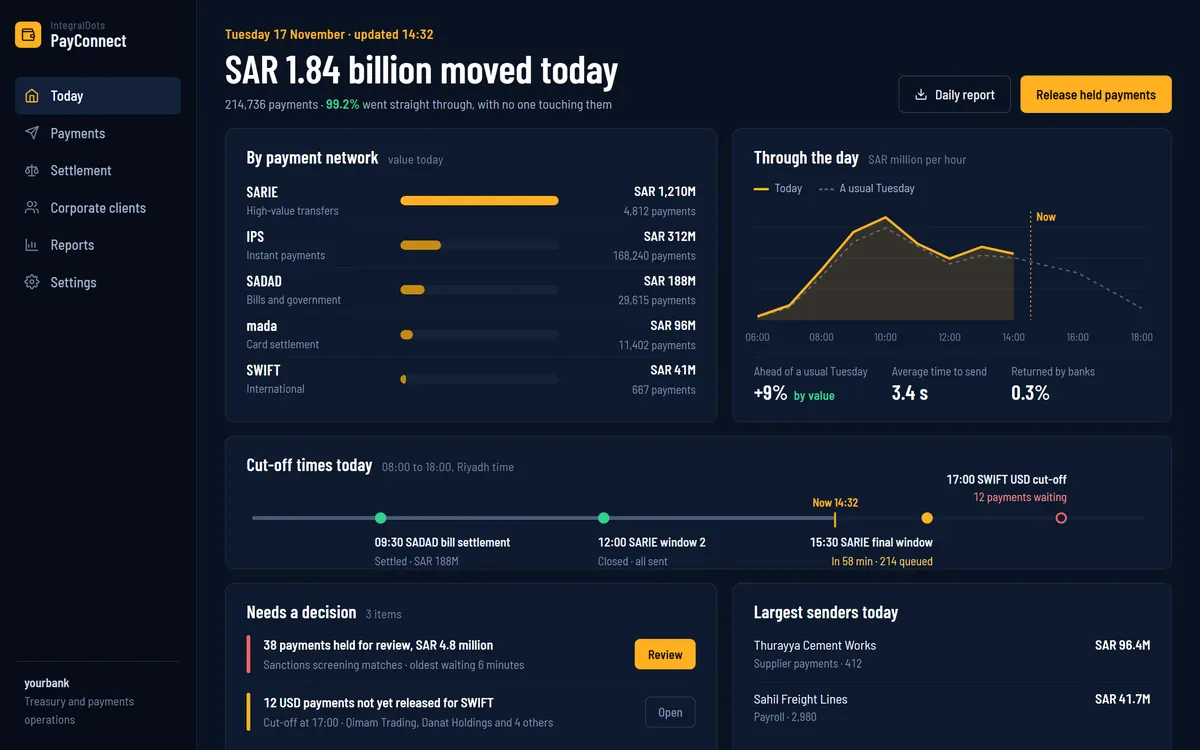 Payments
PayConnect Payment integration suite
The layer between your payment hub and your core, for instant, bulk and biller payments.
Explore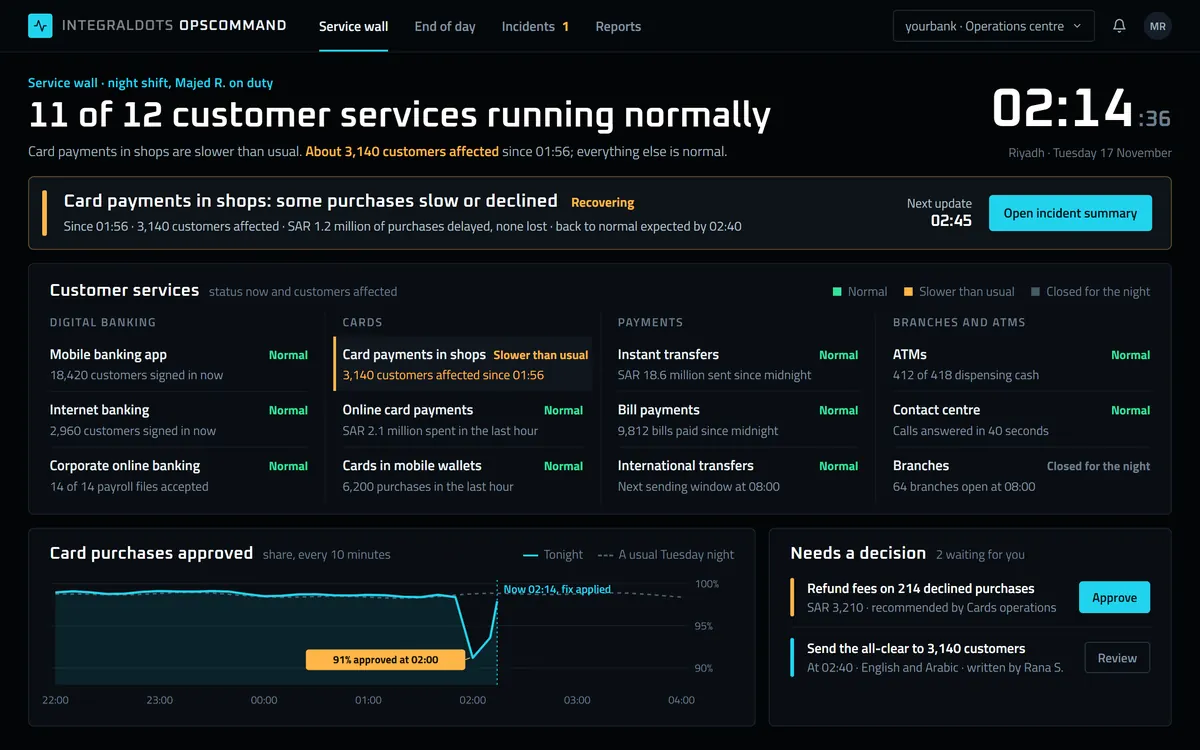 Operations
OpsCommand Operations command center
Every platform, queue and batch job on one wall, with the workflow to act on it.
Explore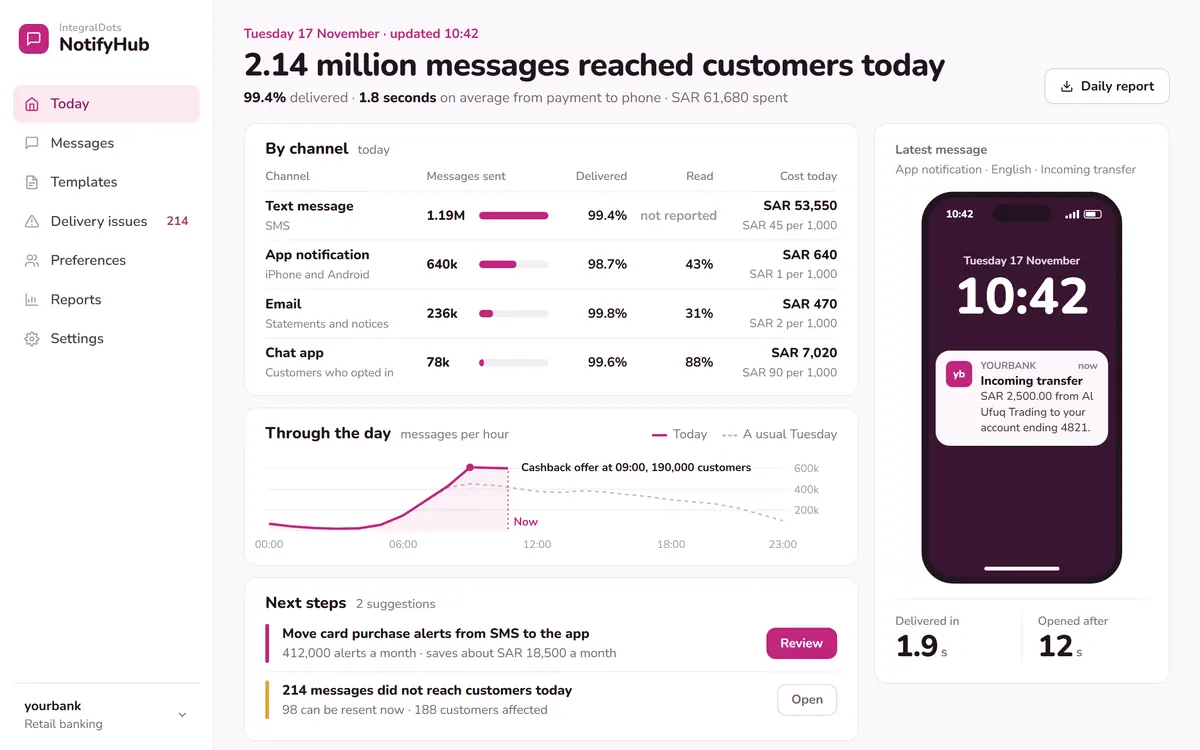 Foundation
NotifyHub Notification hub
Publish once; the hub delivers by SMS, email, push and in-app, and tracks every message.
Explore