IntegralDots KYCLink Identity and KYC gateway
One contract over Nafath, Yakeen and Absher OTP, for every channel you run.
KYCLink puts one verification API in front of the Saudi identity stack. It runs the eKYC steps for each journey, routes one-time passwords, and applies the timeouts, retries and circuit breakers that government-facing integrations need. Personal data is handled under rules you set per field, and stays in the Kingdom.
- ProvidersNafath, Yakeen and Absher OTP
- ChannelsMobile, web, branch and call centre
- RunsInside your network or private cloud
- Built forOnboarding that can't afford identity downtime
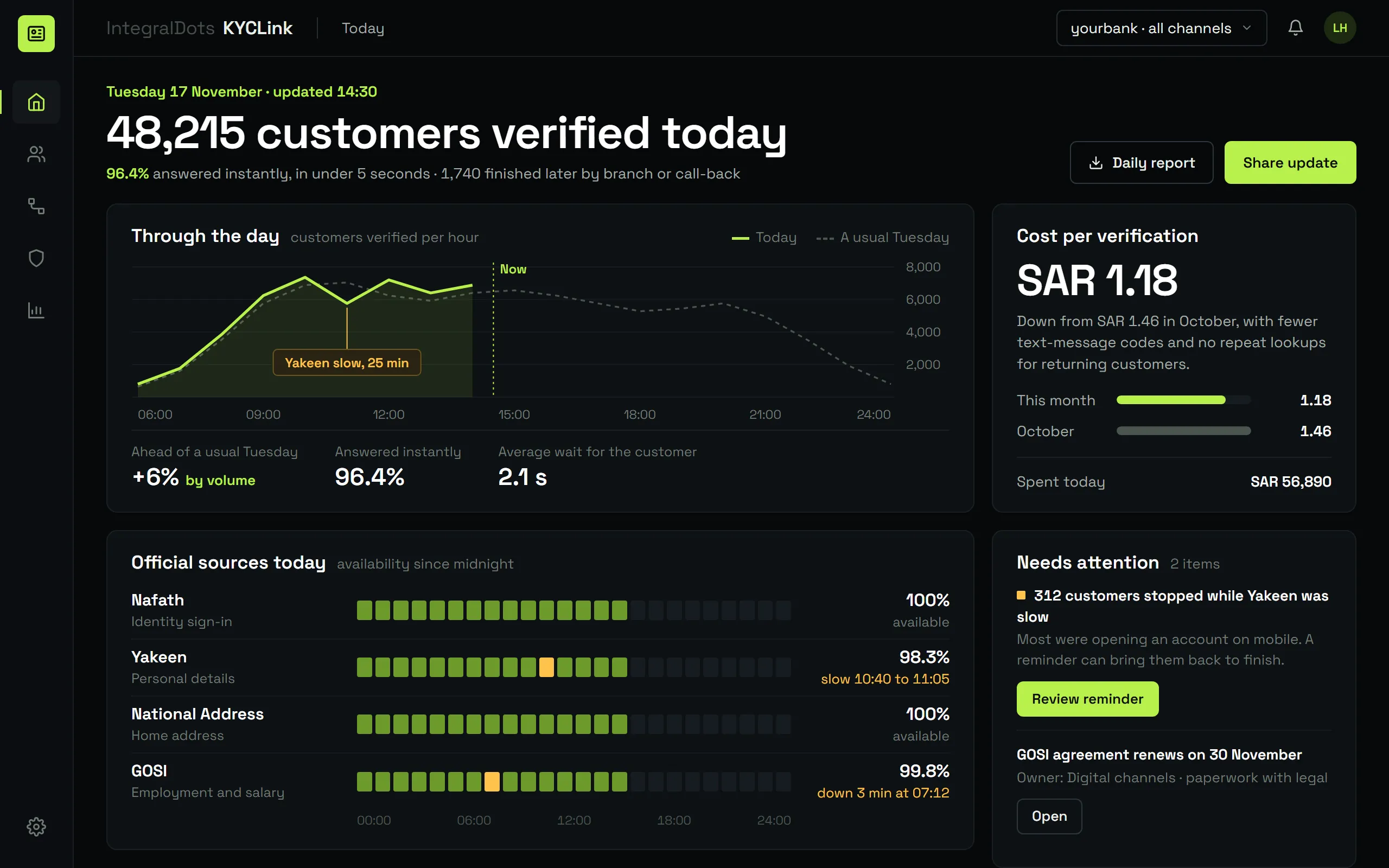
- Today at a glanceCustomers verified so far today and the share answered instantly, in under five seconds.
- Through the dayVolume per hour against a usual Tuesday, with the slow spell at Yakeen marked on the line.
- Official sourcesAvailability of Nafath, Yakeen, National Address and GOSI since midnight, hour by hour.
- Cost and follow-upCost per verification against last month, and the items that need someone to act.
Product screens show demo data.
Every channel built its own road to the identity rails.
Mobile, web, branch and call-centre teams each integrated Nafath, Yakeen and OTP on their own, with their own error handling and their own copies of personal data. When a provider slows down, every channel finds out separately, usually from customers.
- Duplicate integrationsThe same provider calls built three or four times, each with different timeouts, retries and error messages.
- Their downtime is yoursA slow identity lookup stalls account opening in every channel at once.
- OTP as a black boxNo single view of which route delivered a password, how long it took, or when to fail over.
- Personal data sprawlIdentity fields copied into channel logs and databases, with no single rule for what is kept or for how long.
One API call for each verification.
Channels call one API with a journey and a purpose. The gateway runs the steps and returns the same answer format every time.
Call
A channel calls the gateway with the journey, the customer's ID number and the purpose, authenticating as its own API client.
Orchestrate
The gateway runs the journey's steps in order: Nafath sign-in, Yakeen lookup, your rules and an OTP, as the journey defines.
Protect
Each provider call runs under its resilience policy, and only the fields the journey needs are requested, masked and kept.
Answer
The channel receives one result with an evidence reference. The full trace stays in the gateway for audit.
The identity layer your channels share.
eKYC journeys as configuration
Steps, order, rules and outcomes per journey: account opening, step-up, profile change, re-KYC. Change a journey without a channel release, once a second person approves it.
Nafath and Yakeen, handled properly
Nafath requests with number match, approval windows and clear outcomes for expired or rejected requests. Yakeen lookups that ask for named fields only, with name matching and ID expiry checks.
OTP gateway and routing
Absher OTP and your SMS providers behind one interface, routed by message type and live delivery rate, with failover, attempt limits and delivery tracking.
Built for government APIs
Timeouts, retries with backoff, circuit breakers, concurrency caps and holding queues, applied as one policy template per provider, with source availability shown on the daily overview.
PDPL-aware by default
A purpose recorded for every journey, fields minimised and masked in logs, retention set per field, and data kept in the Kingdom.
One contract for every channel
A versioned REST API described in OpenAPI 3.1, with its own client and credentials for each channel. Channels move over one at a time.
Built for the teams who own onboarding.
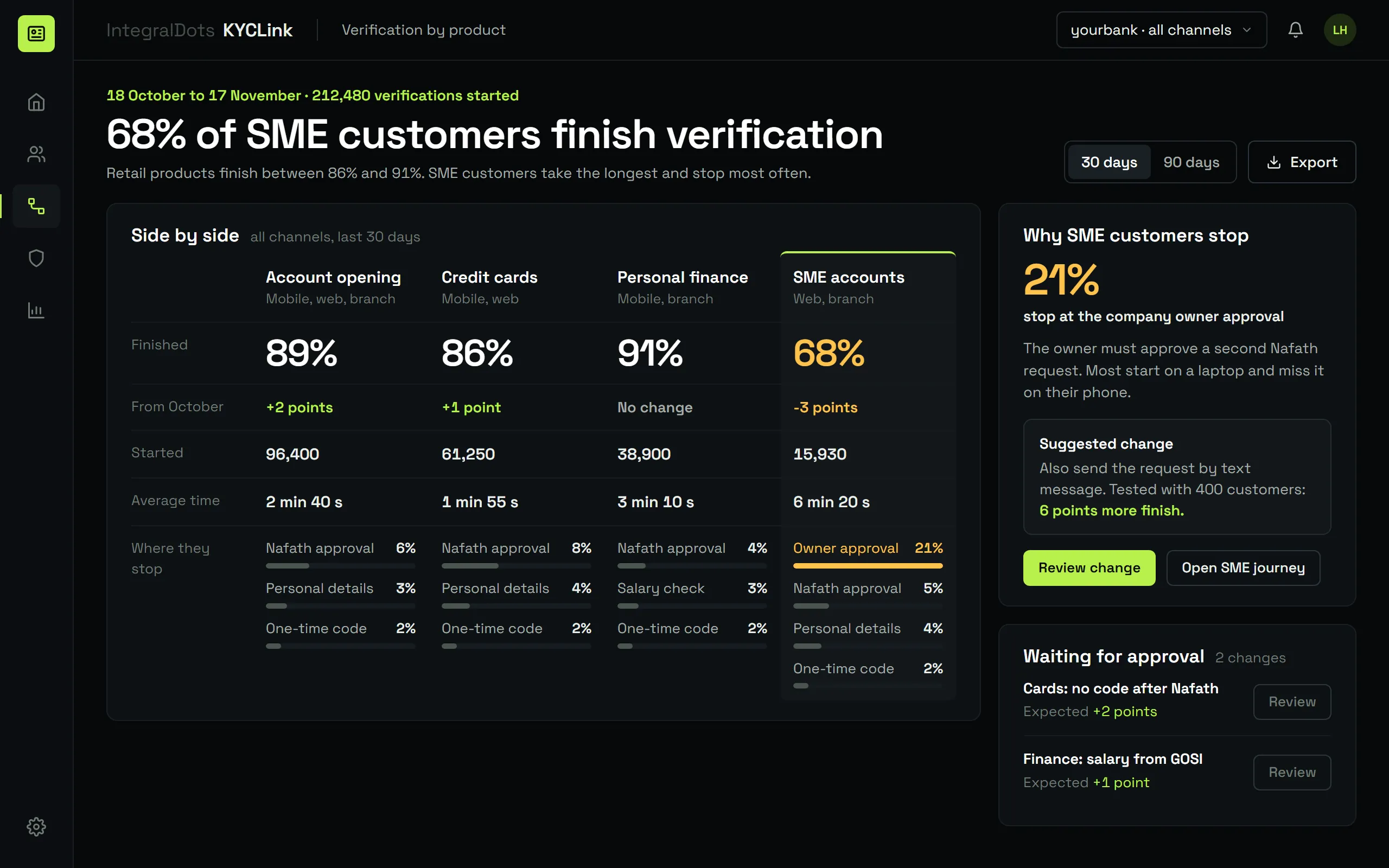
Verification compared by product
Product and risk teams compare how customers get through verification for each product, see the step where they stop, and approve changes to a journey.
- The main findingThe result that matters most this month, stated in one sentence.
- Side by sideCompletion, change from last month, volume and average time for account opening, cards, personal finance and SME.
- Where customers stopThe drop-off at each step of each journey. For SME accounts the largest is the company owner approval.
- Reason and changeWhy customers stop, a change tested with real customers, and the changes waiting for approval.
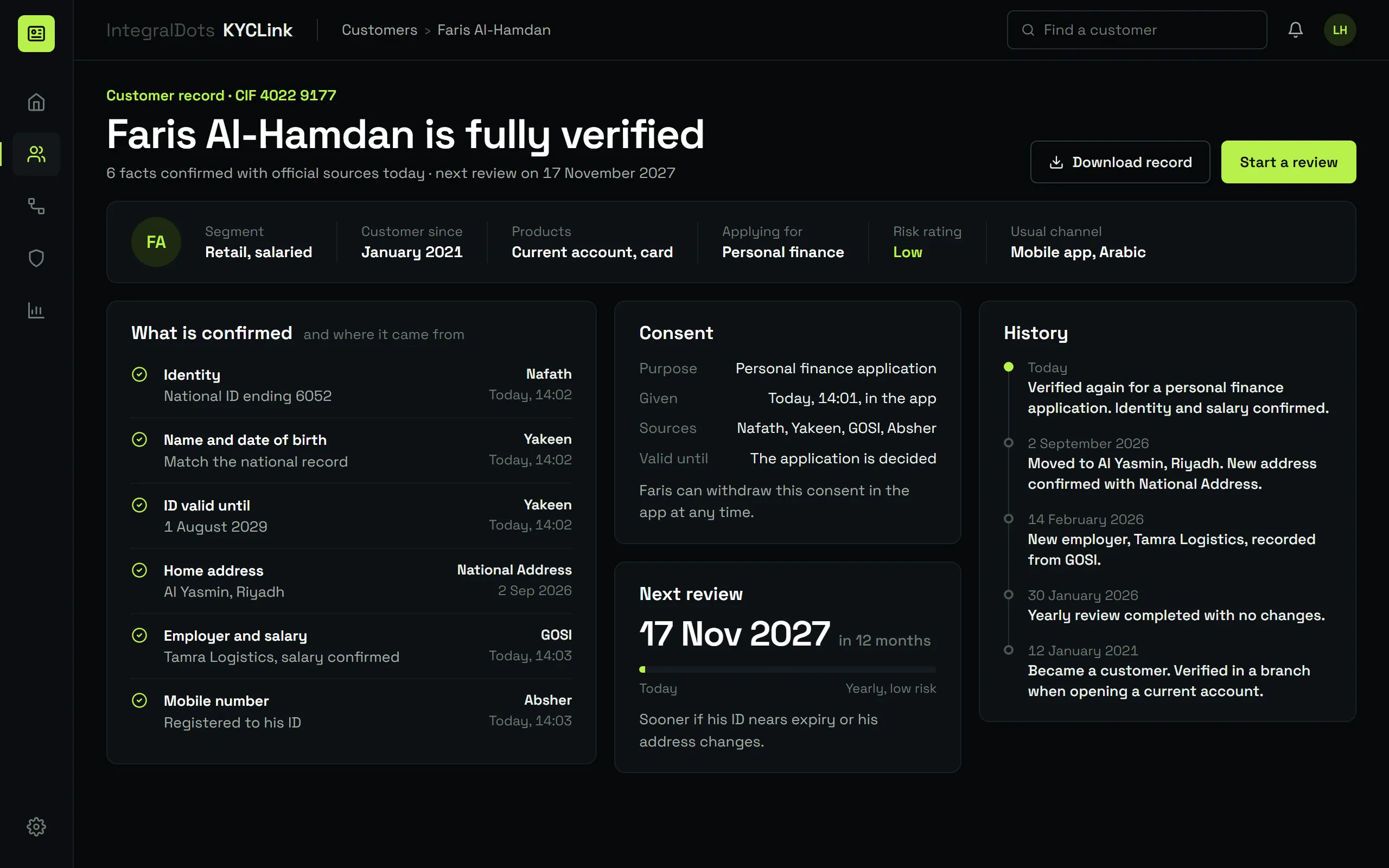
One verified customer record
Each customer record shows what has been confirmed, which official source confirmed it and when, the consent that allowed it, and the date of the next review.
- StatusWhether the customer is fully verified, with the profile details the KYC team needs.
- Confirmed factsEach fact with the official source that confirmed it and the time of the check.
- Consent and next reviewThe purpose and sources the customer agreed to, and when the record is due for review.
- HistoryChanges to the record in plain sentences, from the first verification to today.
Runs inside your boundary.
Identity data is among the most sensitive data you hold. The gateway keeps it in your environment and asks providers only for what each journey needs.
Deployment
- Your data centre or private cloud in the Kingdom
- Active-active, with health checks and alerting
- Sits behind your existing API gateway or integration layer
- Channels move over one at a time, with no big-bang cutover
Security
- mTLS to providers and to each channel client
- OAuth 2.0 client credentials with short-lived tokens
- Provider credentials kept in your vault or HSM
- Single sign-on and role-based access to the console
Data protection
- A purpose recorded for every journey
- Field-level minimisation, and masking in logs
- Retention set per field, following your records policy
- Every view of a verification record logged
Integration
- OpenAPI 3.1 contract shared by every channel
- Events to your SIEM and monitoring tools
- Referrals into your case or KYC workflow
- The identity layer under VerifyFlow
- PDPL data handling
- SAMA Cyber Security Framework controls
- OAuth 2.0
- mTLS
- OpenAPI 3.1
Questions onboarding and architecture teams ask
Do we need our own agreements with Nafath, Yakeen and Absher?
Yes. The gateway calls each provider with your organisation's credentials, under your agreements and the scopes they allow. It does not resell access. We help with the technical side of onboarding to each provider and with moving existing integrations over.
What happens when Nafath or Yakeen is slow or down?
Each provider call runs under its resilience policy: a timeout, a limited number of retries with backoff, and a circuit breaker that stops sending traffic when errors pass a threshold. While the breaker is open, requests are held for a set time and resumed, or referred to a branch or manual check, as the journey defines. Channels receive a clear status instead of a timeout.
Do our channels need to change?
They call one API instead of several. The gateway can sit behind your current API gateway, and channels move over one at a time, so mobile can switch before branch or the call centre.
What personal data does the gateway keep?
Only the fields a journey needs, for the purpose recorded against it. Fields are masked in logs, retention is set per field, and the data stays in your environment in the Kingdom. Every view of a verification record is logged.
How does it relate to VerifyFlow?
VerifyFlow builds on KYCLink for Nafath sign-in and identity checks. It adds consent across more sources, such as GOSI, Mudad, National Address and open banking, along with eligibility rules, fees and an officer workbench.
Related products
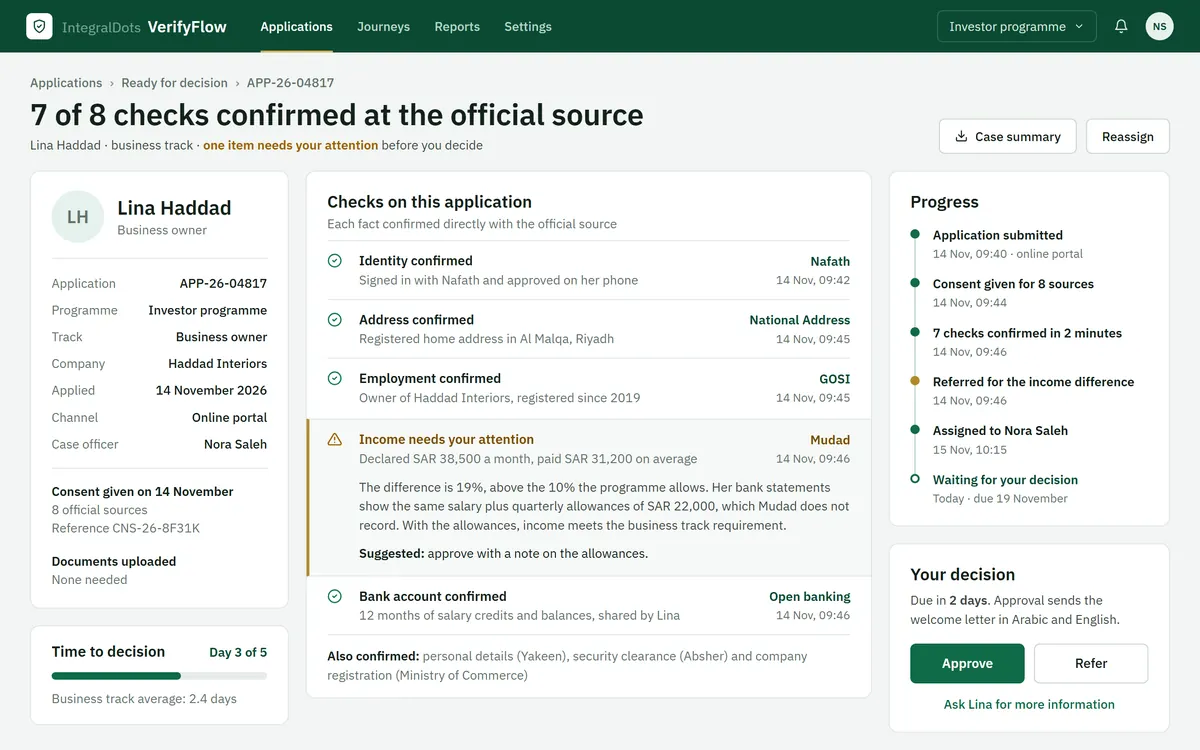 Digital government · Early access
VerifyFlow Verified onboarding platform
Built on KYCLink: consent once, verify applicant facts at source, decide by readable rules.
Explore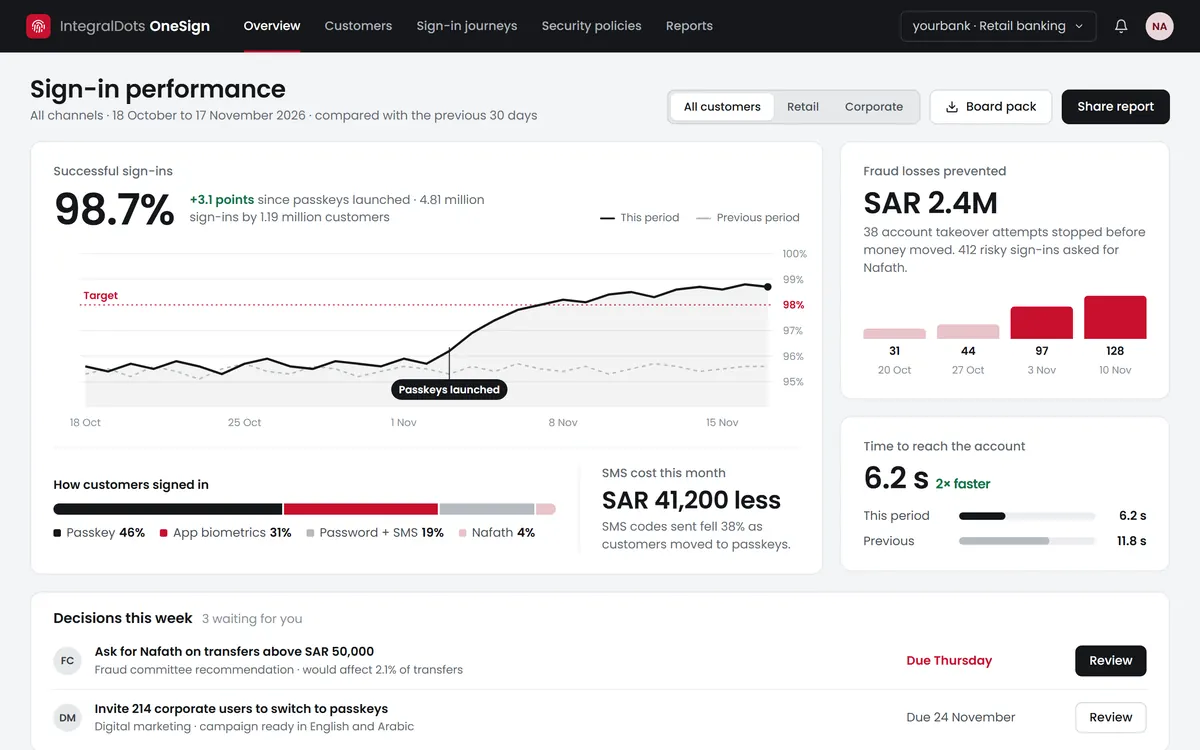 Identity
OneSign Customer identity and access (CIAM)
One customer identity across every channel, with adaptive authentication and Nafath federation.
Explore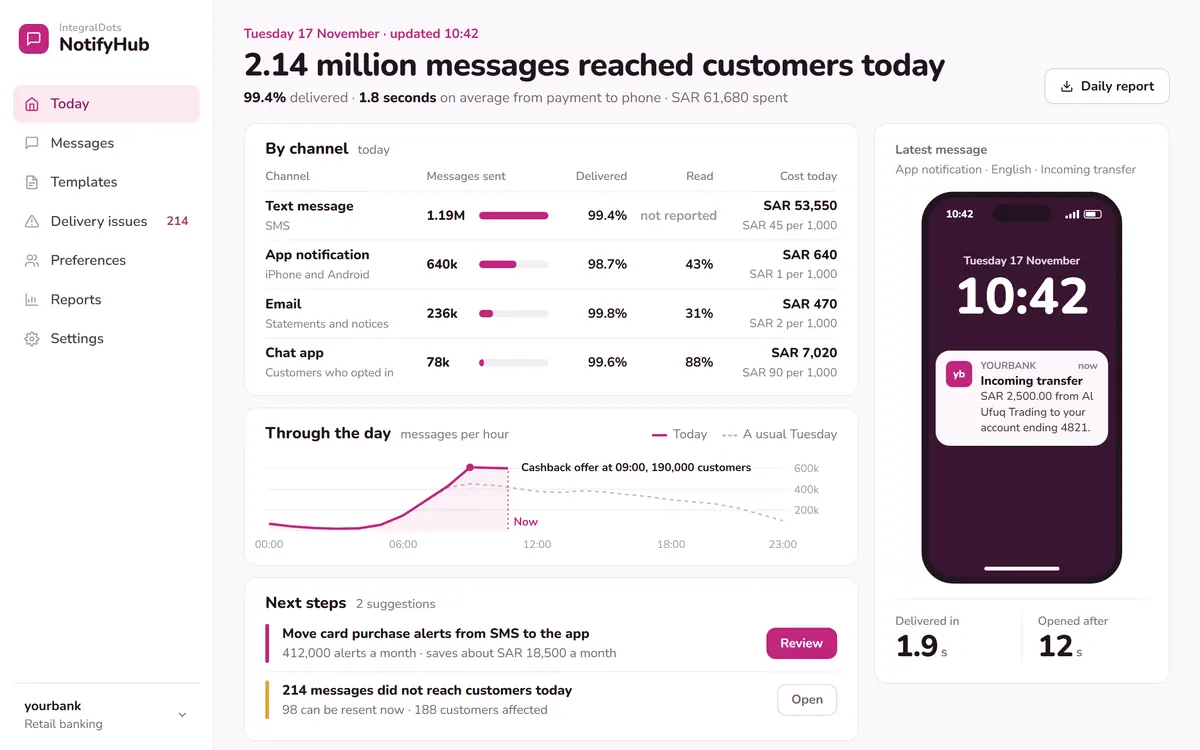 Foundation
NotifyHub Notification hub
Publish once; the hub delivers by SMS, email, push and in-app, and tracks every message.
Explore