IntegralDots DataShift Data migration platform
Migration day run as a procedure your team has already rehearsed and timed.
DataShift takes data from legacy to target systems through versioned transformation pipelines, proves the result with row-level and control-total reconciliation, and rehearses the whole cutover, rollback included, on production-shaped data before anyone touches production.
- MovesCustomers, accounts, balances and history
- ProvesRow-level and control-total reconciliation
- RehearsesDry runs on production-shaped data
- Cuts overWith checkpoints and a tested rollback
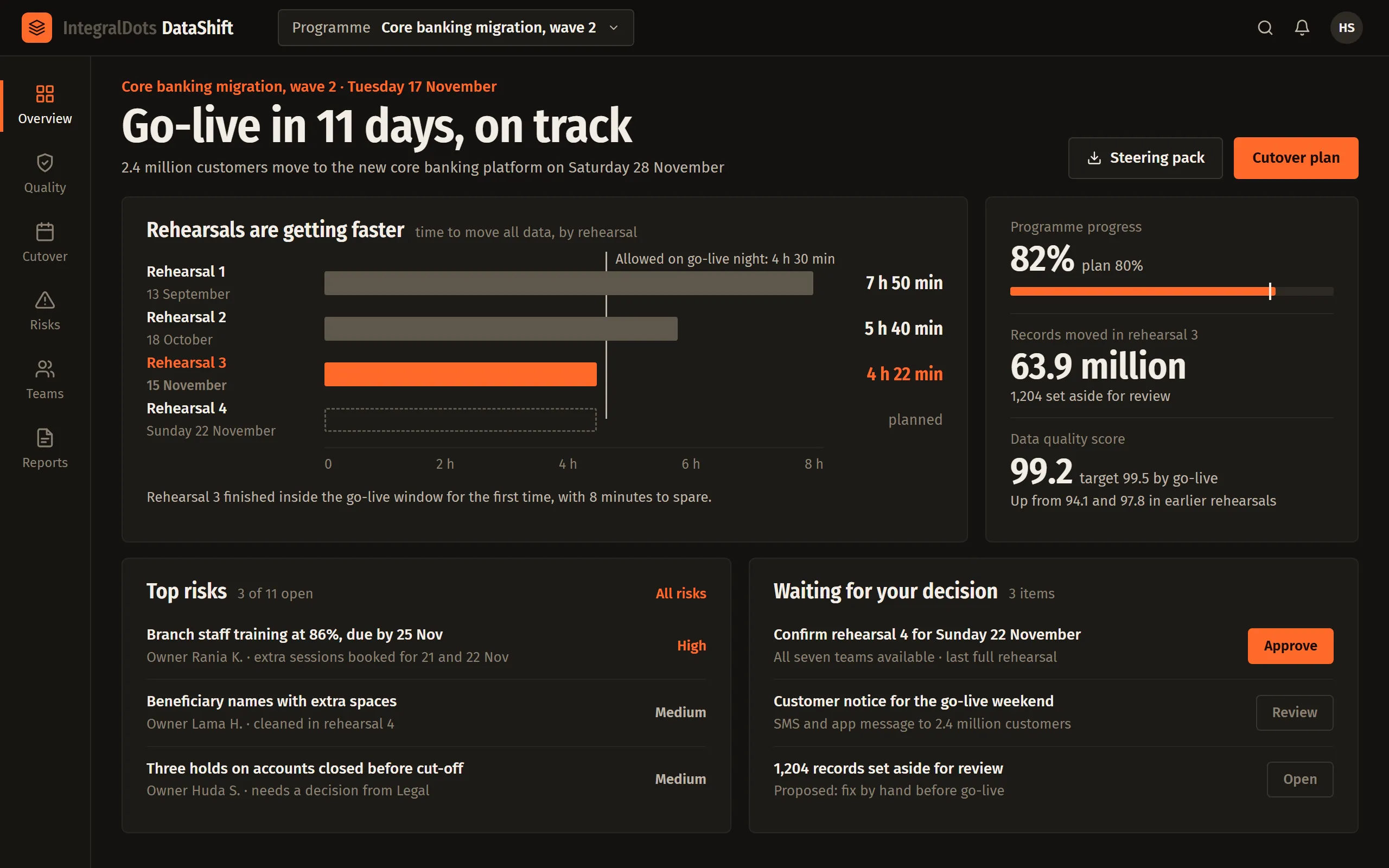
- Days to go-liveGo-live in 11 days and on track, with 2.4 million customers moving on Saturday 28 November.
- RehearsalsEach full rehearsal timed against the 4 h 30 min allowed on go-live night. Rehearsal 3 was the first to fit.
- Where the programme standsProgress against plan, records moved in the last rehearsal and the data quality score against its go-live target.
- Risks and decisionsThe top risks, each with an owner and the next step, beside the decisions waiting for the steering committee.
Product screens show demo data.
A migration is only as good as the proof behind it.
Core replacements, mergers and platform changes all end with a night when data moves for good. Too often the mappings live in spreadsheets, scripts change up to the last minute, reconciliation is a sample check, and the rollback has never been run. The business is asked to sign off on trust.
- Spreadsheet mappingsField mappings and rules sit in documents that drift away from the code that actually runs.
- Untested at scaleScripts are tried on small extracts and meet full volumes and real data quality for the first time on the night.
- Sample-based checksA few totals and a sample of records are checked, so differences surface after go-live, as customer complaints.
- Untried rollbackThe rollback plan exists on paper, but nobody knows how long it takes or whether it works.
Rehearse until the numbers agree.
The same pipeline, checks and runbook are used in every dry run and on the night, so go-live repeats something you have already done.
Profile
Profile every source table: volumes, keys, nulls, formats and anomalies. Findings feed straight into the mapping work.
Map
Map source fields to the target and write transformation rules in the workbench. Each mapping set is versioned and approved.
Rehearse
Run the full pipeline on a masked, production-shaped copy. Every rejected row is quarantined with a reason code.
Reconcile
Compare control totals and every row between source and target. Each difference must be explained before sign-off.
Cut over
Run the rehearsed runbook with checkpoints. If a checkpoint fails before the point of no return, roll back.
Everything a migration programme has to prove.
Profiling and mapping
Source profiling across systems, field-level mappings, transformation rules and reference-data lookups in one place, linked to the pipeline that runs them.
Versioned transformation pipelines
Extract, transform, validate and load as versioned pipelines. A change to a mapping or rule is approved before it reaches a dry run.
Dry runs on production-shaped data
Full-volume rehearsals on masked copies of production, timed and compared run to run, so the cutover plan rests on measured durations.
Row-level and control-total checks
Counts, amount totals and key hashes per entity, then a field-by-field comparison of every row, keyed on the legacy-to-new ID cross-reference.
Evidence packs for sign-off
Control totals, row comparison results, the rejects register, the mapping set and the run log, sealed with a hash and signed off by named owners.
Orchestrated cutover
Sequenced steps, go/no-go checkpoints with owners and exit criteria, an agreed point of no return, and a rollback rehearsed end to end.
Built for the migration lead, data control and the steering committee.
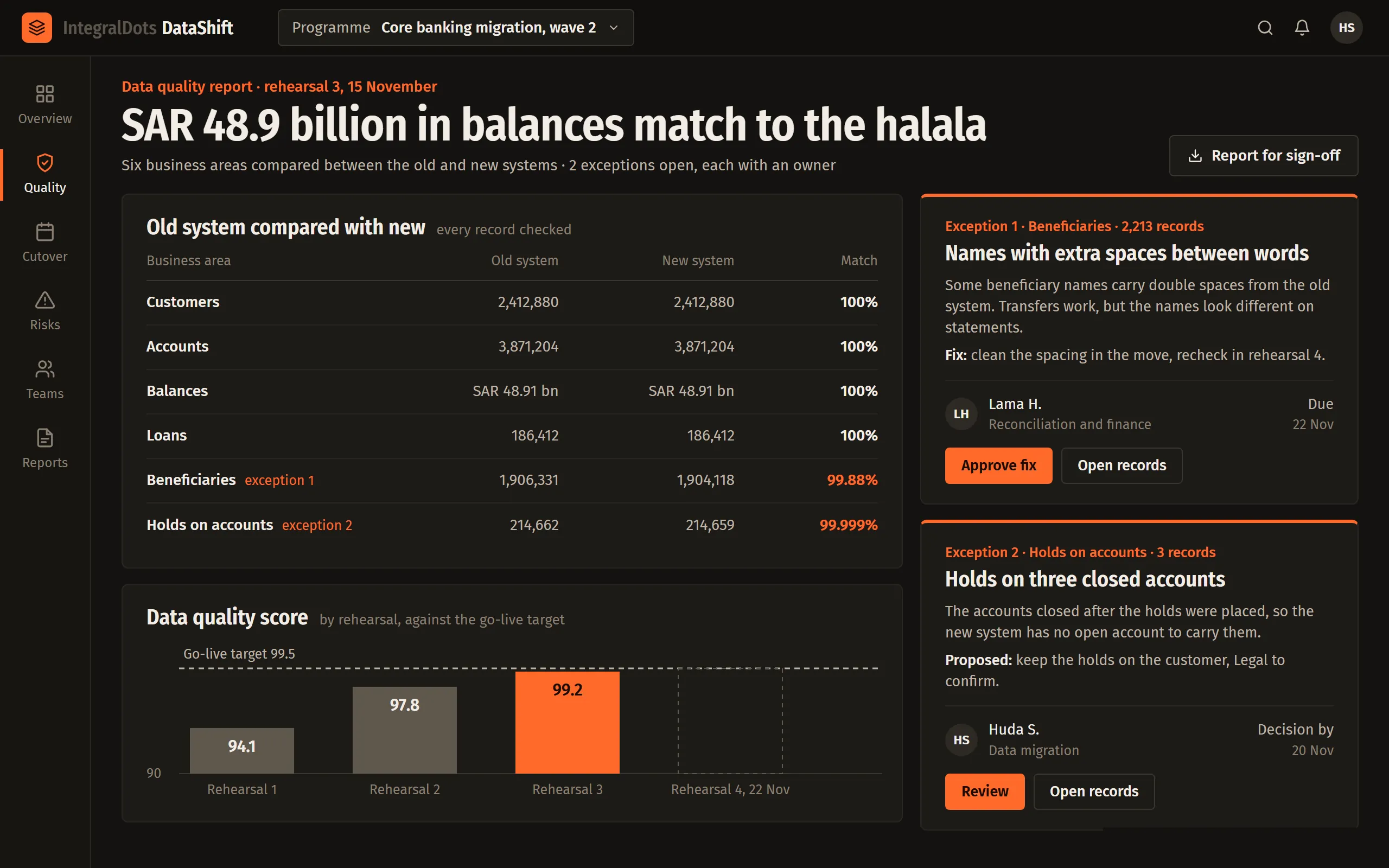
Old and new systems compared record by record
After each rehearsal, DataShift compares every customer, account, balance and loan record between the old and new systems. Business areas that match in full show 100%. Anything else becomes an exception with a plain explanation, an owner and a due date.
- HeadlineSAR 48.9 billion in balances agree to the halala after rehearsal 3.
- Business areasCustomers, accounts, balances, loans, beneficiaries and holds, with counts from both systems and the match rate.
- Exceptions in contextThe two business areas that do not match in full are marked and linked to their exception.
- Quality scoreThe data quality score for each rehearsal against the 99.5 needed before go-live.
- Exceptions with ownersEach exception explained in plain words, with the fix or proposal, an owner, a due date and a button to act.
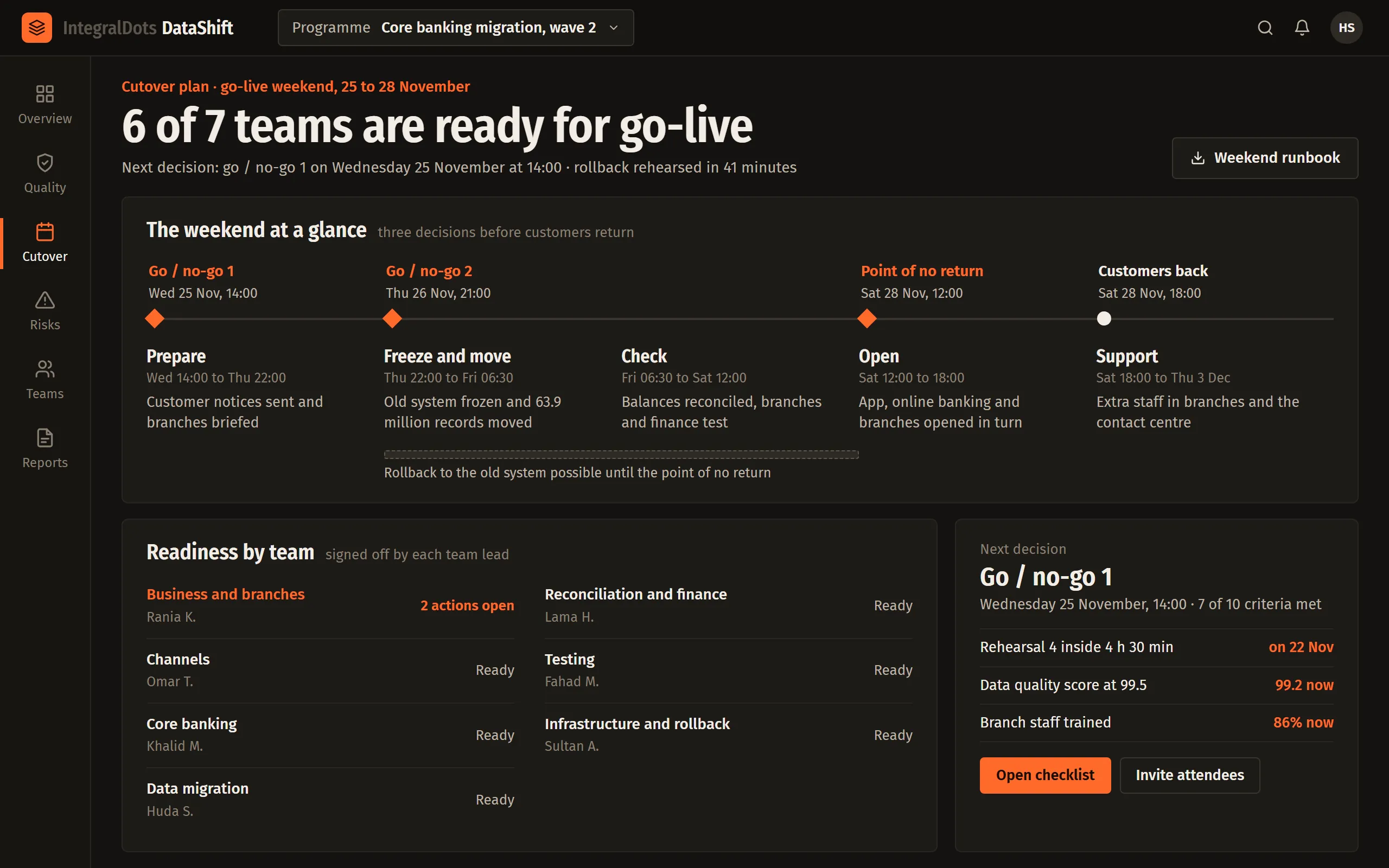
The go-live weekend on one page
The plan shows the weekend as five stages with the decisions between them: two go / no-go meetings, the point of no return and the moment customers are back. Below it, each team lead signs off readiness, and the next decision lists the criteria still open.
- HeadlineSix of seven teams ready, with the date of the next decision and the time a full rollback took in rehearsal.
- GatesGo / no-go 1 and 2, the point of no return at Saturday 12:00 and customers back at 18:00.
- Stages and rollbackPrepare, freeze and move, check, open and support, with the window in which a rollback to the old system is still possible.
- Readiness by teamSeven teams and their leads. The one team with open actions stands out.
- Next decisionGo / no-go 1 with the criteria not yet met, and buttons to open the checklist or invite attendees.
Production data, handled inside your boundary.
A migration touches every customer record. DataShift keeps data in your environment and masks it wherever it is not needed.
Deployment
- Your data centre or private cloud, close to source and target systems
- Data stays in your environment throughout
- Scales out for full-volume dry runs
- Separate rehearsal and production environments
Security
- Personal data masked in rehearsal copies, under your policy
- Single sign-on, with separate roles for mapping, approval and execution
- Encryption in transit and at rest
- Least-privilege, time-bound credentials for source and target databases
Governance
- Maker-checker approval for mappings, rules and pipeline versions
- Evidence packs sealed with a hash and signed off by named owners
- Full run logs for every dry run and for the cutover
- Retention that follows your records policy
Integration
- Relational databases and file-based sources
- Target bulk-load paths or APIs
- Validation rules for IBANs, national IDs and reference data
- Exports to your reporting and data platform
- PDPL data handling
- SAMA Cyber Security Framework controls
- IBAN (ISO 13616) validation
- SAML and OpenID Connect SSO
Questions programme leaders ask
Which systems can it migrate between?
Relational databases and file-based sources on the legacy side, and the target's bulk-load paths or APIs on the other. Most of the effort goes into the mappings and rules, which are specific to each programme.
Do dry runs need production data?
They use a production-shaped copy: real volumes and structure, with personal data masked under your policy. That is what makes the timings and data-quality findings reliable.
What does "reconciled" mean here?
Each entity's counts, amount totals and key hashes agree between source and target, and every row is compared field by field. Any difference has to be explained by the rejects register before sign-off.
Can one cutover cover several databases?
Yes. One runbook can promote several databases in sequence, each with its own seed and reference-data plan, checkpoints and rollback steps.
Does it replace our migration team or integrator?
No. It gives your team and your integrator one place for mappings, pipelines, evidence and the runbook. We can also deliver the migration with you as a service.
Related products
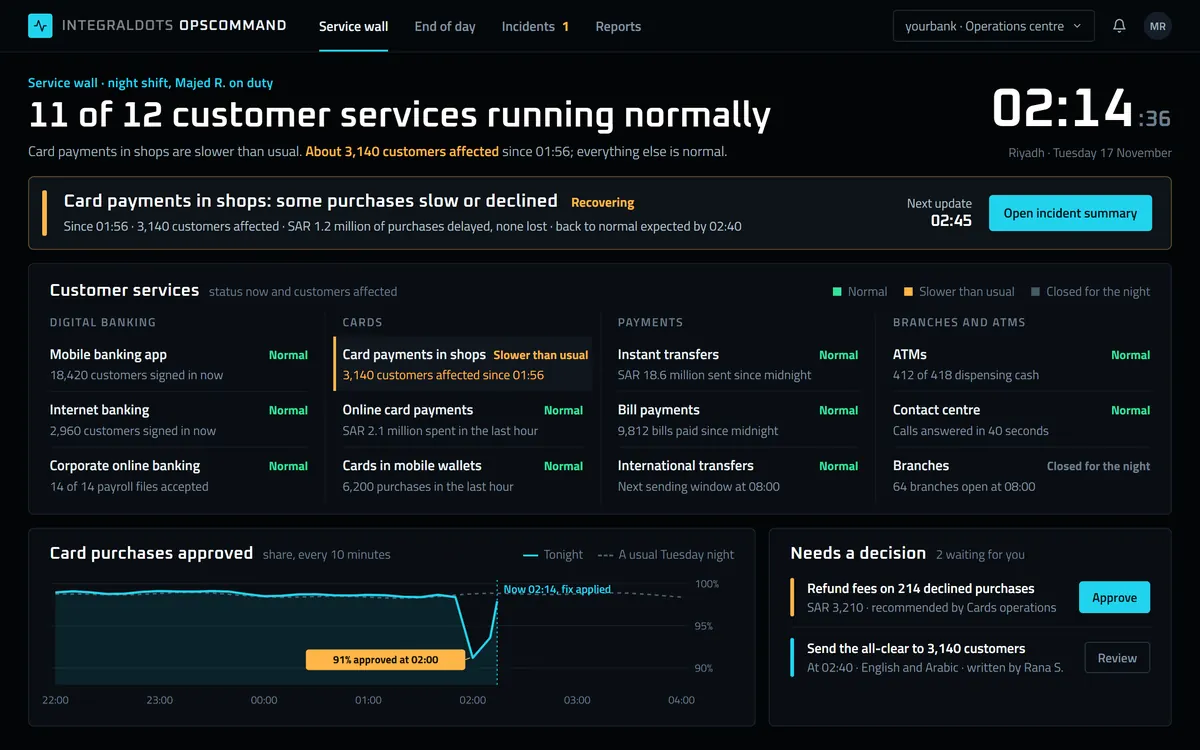 Operations
OpsCommand Operations command center
Every platform, queue and batch job on one wall, with the workflow to act on it.
Explore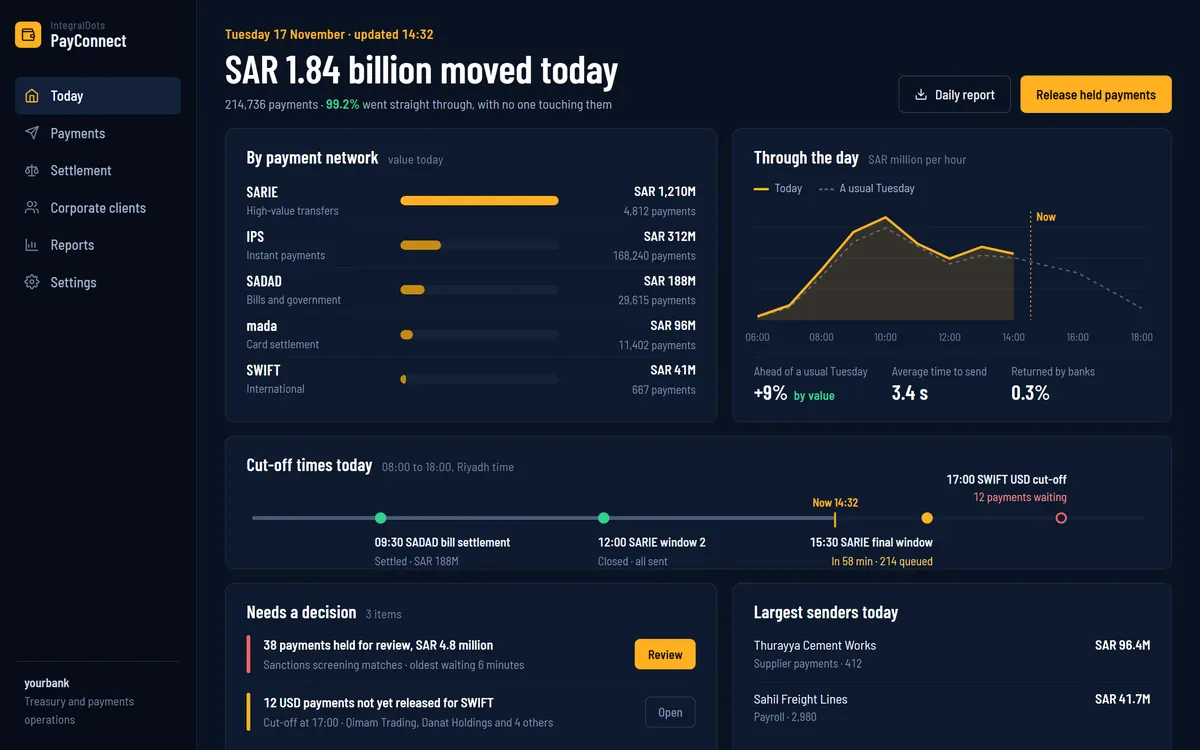 Payments
PayConnect Payment integration suite
The layer between your payment hub and your core, for instant, bulk and biller payments.
Explore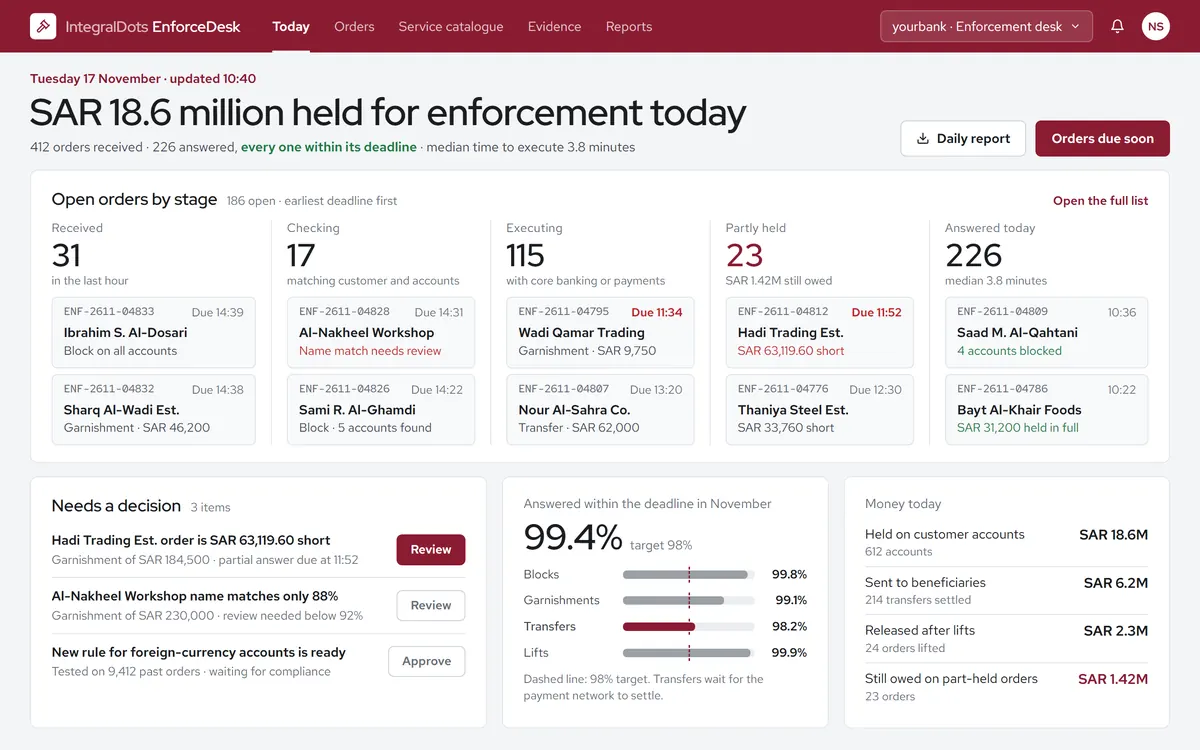 Regulatory
EnforceDesk Enforcement execution for Tanfeeth
Court-order and regulator-mandated execution under versioned rules, reconciled and audited.
Explore