IntegralDots DebitFlow Direct debit collections
Recurring collections for your corporate clients, as a signed and documented API.
With DebitFlow, billers, insurers, telcos and finance companies collect recurring payments from accounts held at your bank. They open a batch, submit debits and close it with control totals. Your bank checks every item against its mandate, debits the accounts and returns a status for each one, with a reason when it fails.
- ClientsBillers, insurers, telcos, finance companies
- BatchesChecked against control totals before any debit
- SecurityJWT bearer and JWS detached signatures
- APIOpenAPI 3.1 with an integration guide
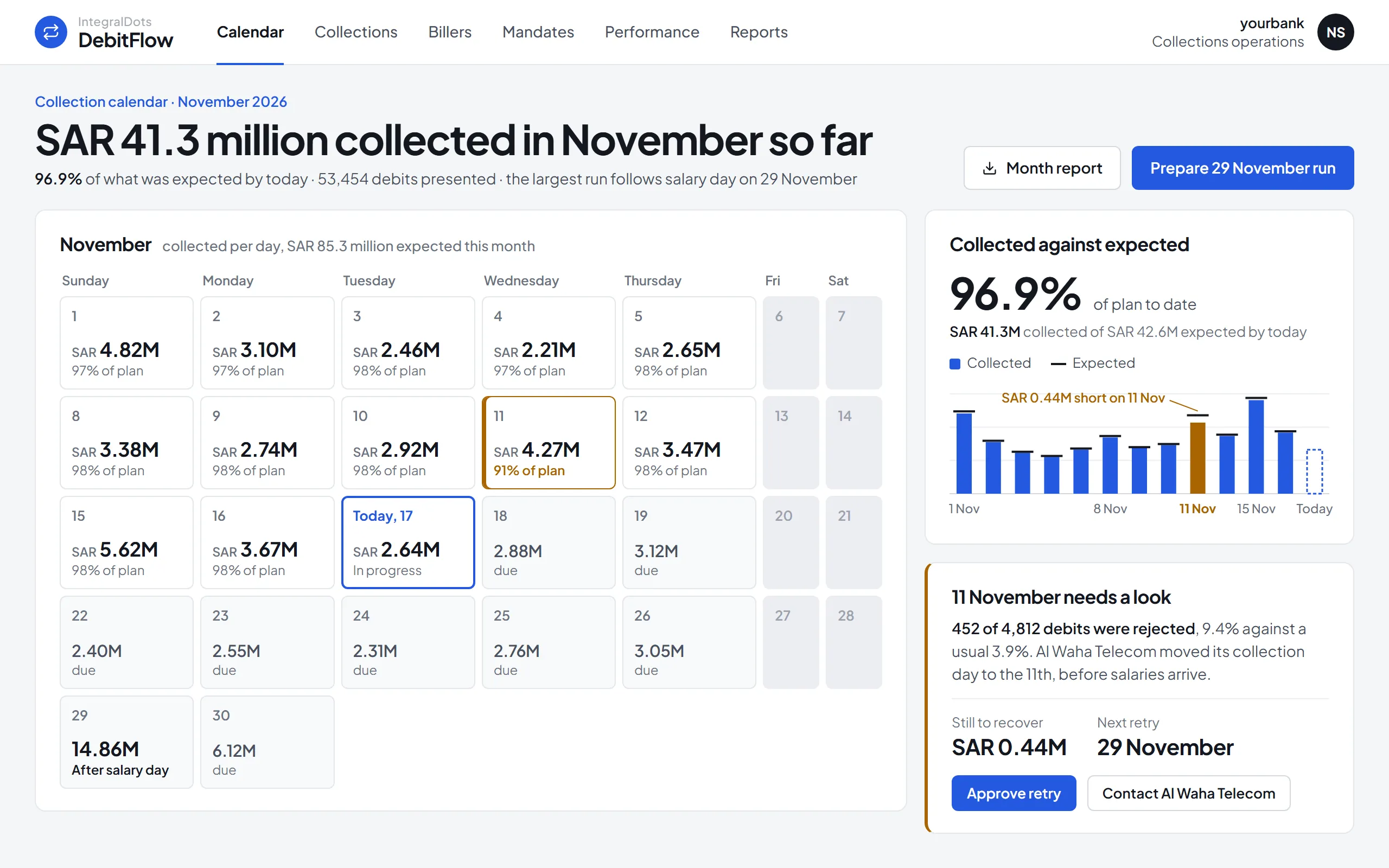
- Month at a glanceEach working day shows the amount collected and its share of plan. Fridays and Saturdays have no collections, and the days ahead show what is due.
- Flagged day11 November collected 91% of plan, against about 98% on the other days.
- Collected against expectedSAR 41.3 million collected of SAR 42.6 million expected by today, day by day, with the SAR 0.44 million shortfall on 11 November marked.
- What happened452 of 4,812 debits were rejected after Al Waha Telecom moved its collection day to the 11th, before salaries arrive. The retry is planned for 29 November.
Product screens show demo data.
Corporate collections still run on files and phone calls.
Corporates that bill thousands of customers every month need to collect reliably and know quickly what failed. Many banks still offer them a file drop and a rejection list days later. Each new client becomes a custom project, and nobody can explain a failed debit without opening a ticket.
- Late feedbackA corporate sends a file and waits days to learn which debits failed, and why.
- Totals that driftA truncated or duplicated file is found only after accounts have been debited.
- Bespoke onboardingEach client gets its own format and shared credentials, so adding the next one takes months.
- Reasons nobody can readFree-text rejection messages make it hard for corporates to decide what to retry and what to stop.
From batch to bank statement, step by step.
The corporate drives a short, predictable API sequence. With DebitFlow, your bank keeps control of mandates, limits and the debit itself.
Onboard
The corporate is checked, signs the collection agreement, passes UAT test cases and registers its signing keys. Production access needs two approvers.
Open a batch
The client opens a batch and declares the number of debits and their total. Every call uses a short-lived JWT and a JWS signature.
Submit
Debits are sent in chunks. Each chunk is idempotent, so a resend after a timeout is recognised and ignored.
Close
On close, the received count and sum are compared with the declaration. If they differ, the batch is rejected and nothing is debited.
Process and report
Each debit is checked against its mandate and posted on the core. The client reads per-item status with ISO 20022 reason codes.
A collections product your clients can integrate in weeks.
Open, submit, close
A clear batch lifecycle with declared and received control totals, chunked submission and processing windows your operations team sets.
Per-transaction results
Every debit returns collected or rejected, with an ISO 20022 reason code such as AM04, AC04, AC06 or MD01, and whether it can be presented again.
Checked before every debit
Each debit is matched to an active mandate, its maximum amount and its frequency. Suspended, cancelled or expired mandates are refused.
Many corporates, one product
Per-client credentials, keys, limits and daily caps, with an onboarding checklist and maker-checker approval before going live.
Signed requests
JWT bearer tokens for access and JWS detached signatures on request bodies, so the bank can prove what each client sent and when.
OpenAPI 3.1 and a guide
A complete OpenAPI 3.1 specification and a client integration guide covering signing, error handling and test cases.
Built for the team that runs collections.

Mandate setup, as the customer sees it
Customers set up a direct debit in the bank's own online banking or app, in four short steps. Nothing is collected until they confirm with a one-time code, and the mandate goes straight into the bank's register.
- In the bank's channelThe page carries the bank brand and an Arabic option. Masar Schools asked for the mandate, and the customer completes it here.
- Four stepsBiller, account, payment terms, then review and confirm. Completed steps are ticked and can be reopened.
- Mandate summaryWho collects, the reference, the account, the monthly amount and its cap, the collection day and the period, with the total over seven payments.
- What the customer agrees toA reminder three days before each payment, a cap above which nothing is collected and the right to pause or cancel in the app, followed by an explicit consent box.
- ConfirmThe customer confirms with a one-time code sent by SMS, and the consent is recorded against the mandate.
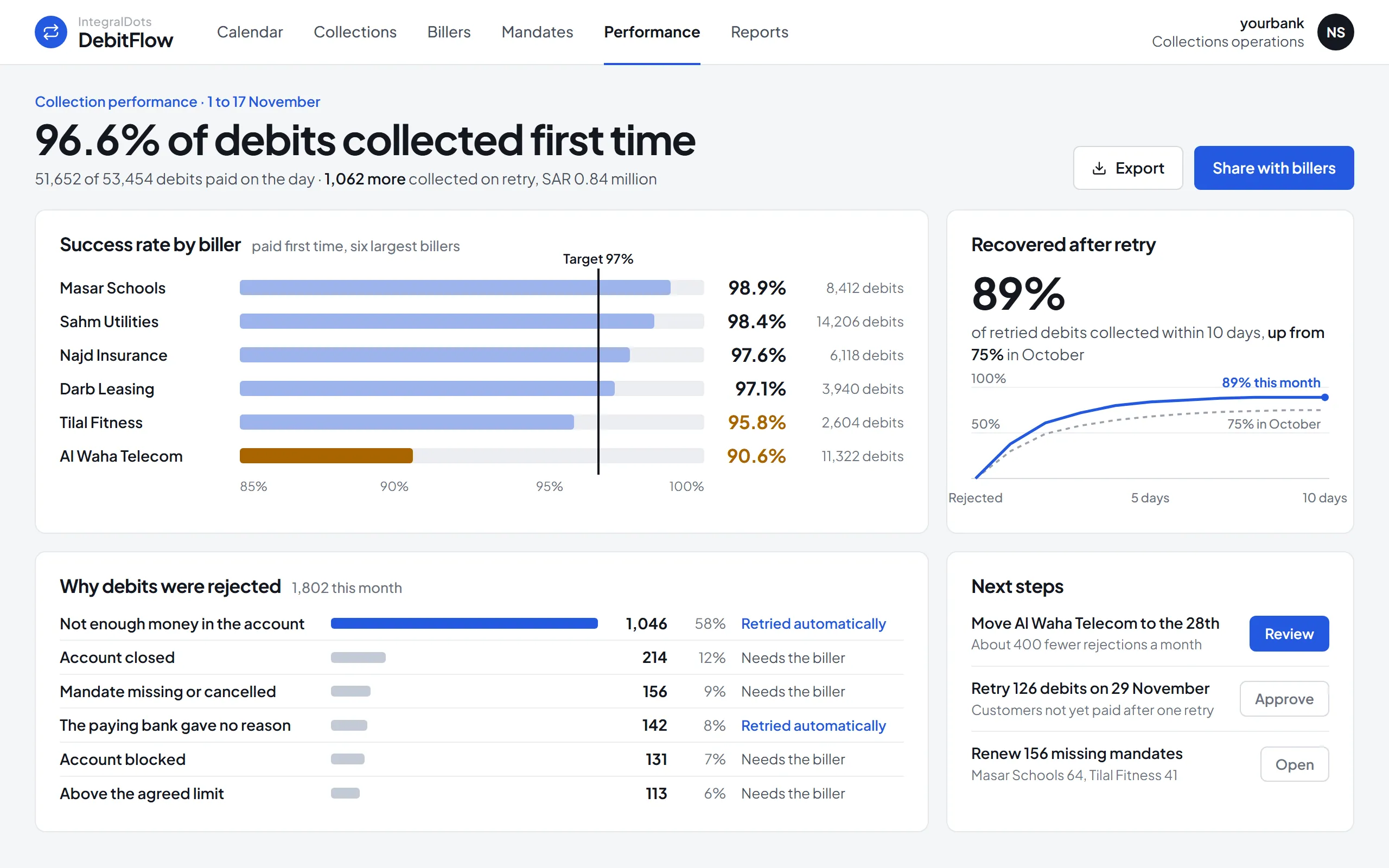
Collection performance by biller and by reason
One page for the head of collections: how many debits are paid first time, which billers fall short of target and why debits are rejected, in plain language. It also shows how much the automatic retries recover.
- Success by billerShare of debits paid first time for the six largest billers, against the 97% target.
- Below targetAl Waha Telecom is at 90.6% since it moved its collection day to the 11th, before salaries arrive.
- Recovered after retry89% of retried debits are collected within 10 days, up from 75% in October, now that retries follow salary dates.
- Why debits were rejectedReasons in plain words, each mapped to its ISO 20022 code in the biller report, and whether DebitFlow retries it or the biller has to act.
- Next stepsMove Al Waha Telecom back to the 28th, approve the next retry and ask billers to renew missing mandates.
Signed requests and a record of every debit.
Deployed inside your bank, behind your API gateway, with your keys and your approval process.
Deployment
- Your data centre or private cloud tenancy
- Published through your existing API gateway
- Separate UAT and production environments for client testing
- Health checks, metrics and alerts into your monitoring
Security
- Short-lived JWT bearer tokens per client
- JWS detached signatures verified on every request body
- Per-client signing keys with overlapping rotation
- Debtor names and account numbers masked on screens and in logs
Governance
- Maker-checker for client activation, key registration and limit changes
- Batch, item and API events logged with the signing key used
- Per-client daily caps and maximum amounts per debit
- Retention that follows your records policy
Integration
- REST API specified in OpenAPI 3.1
- Core banking adapter for debit posting and account status
- Mandate register kept by the bank, checked on every debit
- Reports to your data platform and client notifications through your channels
- OpenAPI 3.1
- JWT (RFC 7519)
- JWS detached content (RFC 7515)
- ISO 20022 reason codes
- PDPL data handling
- SAMA Cyber Security Framework controls
Questions banks and their clients ask
What does a corporate need to build?
A client for a small REST API: get a token, open a batch, submit debits in chunks, close the batch and read the results. The OpenAPI 3.1 specification and the integration guide cover signing, errors and the UAT test cases.
How are requests secured?
Each client has its own credentials and signing keys. Calls carry a short-lived JWT bearer token, and request bodies are signed with a detached JWS signature that the bank verifies against the client's registered key.
What happens if the control totals don't match?
The batch is rejected at close and no account is debited. The client sees the declared and received count and sum, fixes the batch and submits it again.
Who holds the mandates?
Your bank. Every debit is checked against an active mandate, its maximum amount and its frequency before it is posted. Debits without a valid mandate are refused with reason code MD01.
Can corporates see why a debit failed?
Yes. Each transaction returns its status and an ISO 20022 reason code, such as AM04 for insufficient funds or AC04 for a closed account, along with whether it can be presented in a later batch.
Related products
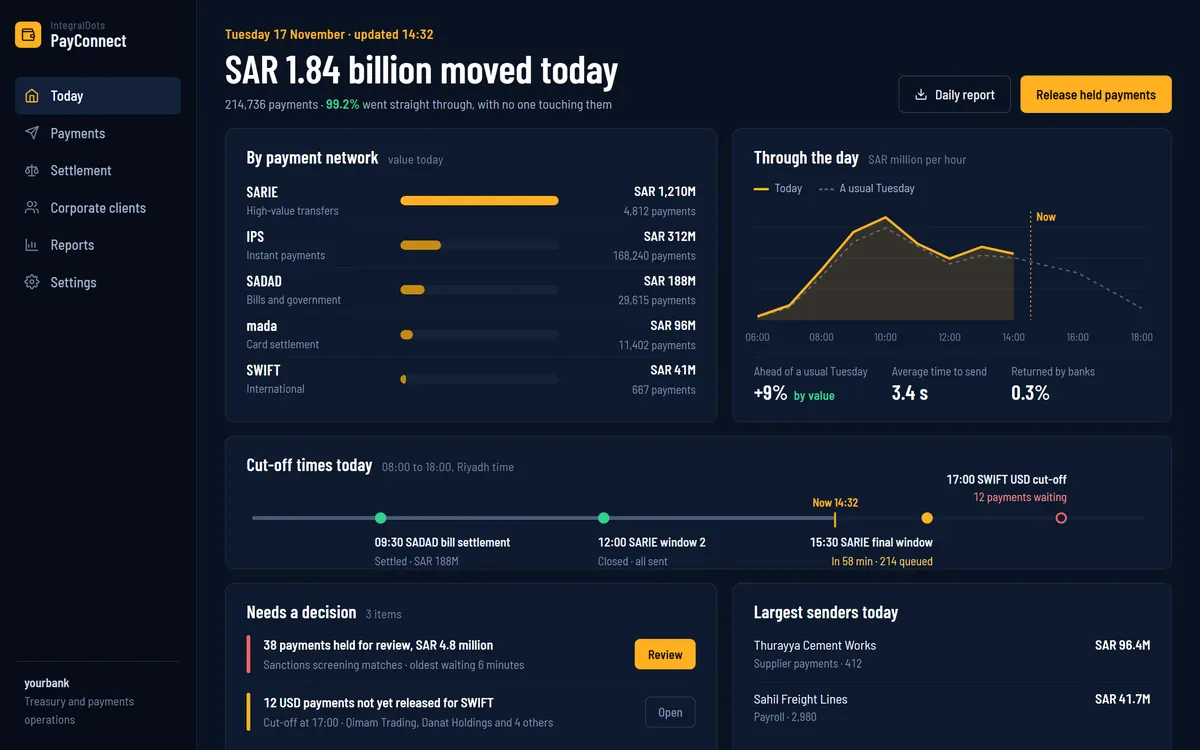 Payments
PayConnect Payment integration suite
Instant, bulk and biller payments between your payment hub and your core, ISO 20022 native.
Explore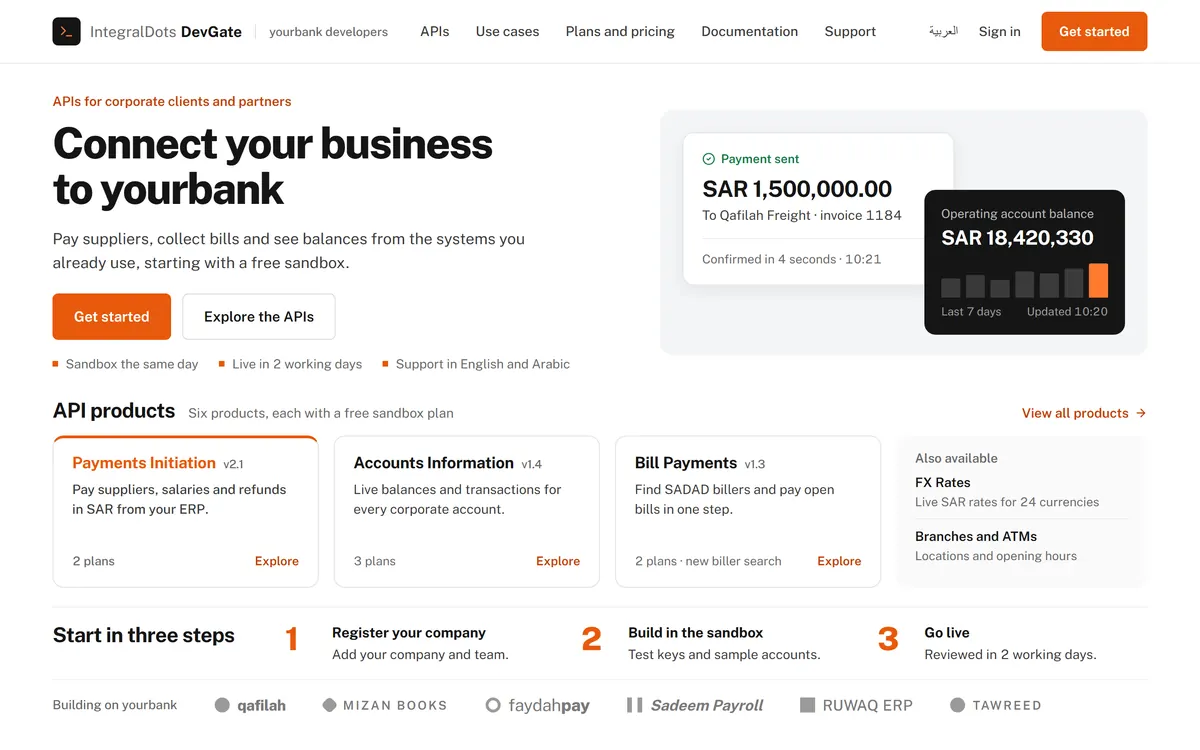 API management
DevGate API developer portal
Documentation, test access and onboarding for the partners and corporates who use your APIs.
Explore Foundation
NotifyHub Notification hub
Publish once; the hub delivers by SMS, email, push and in-app, and tracks every message.
Explore